Alyosha the Pot
A bondade silenciosa de um criado
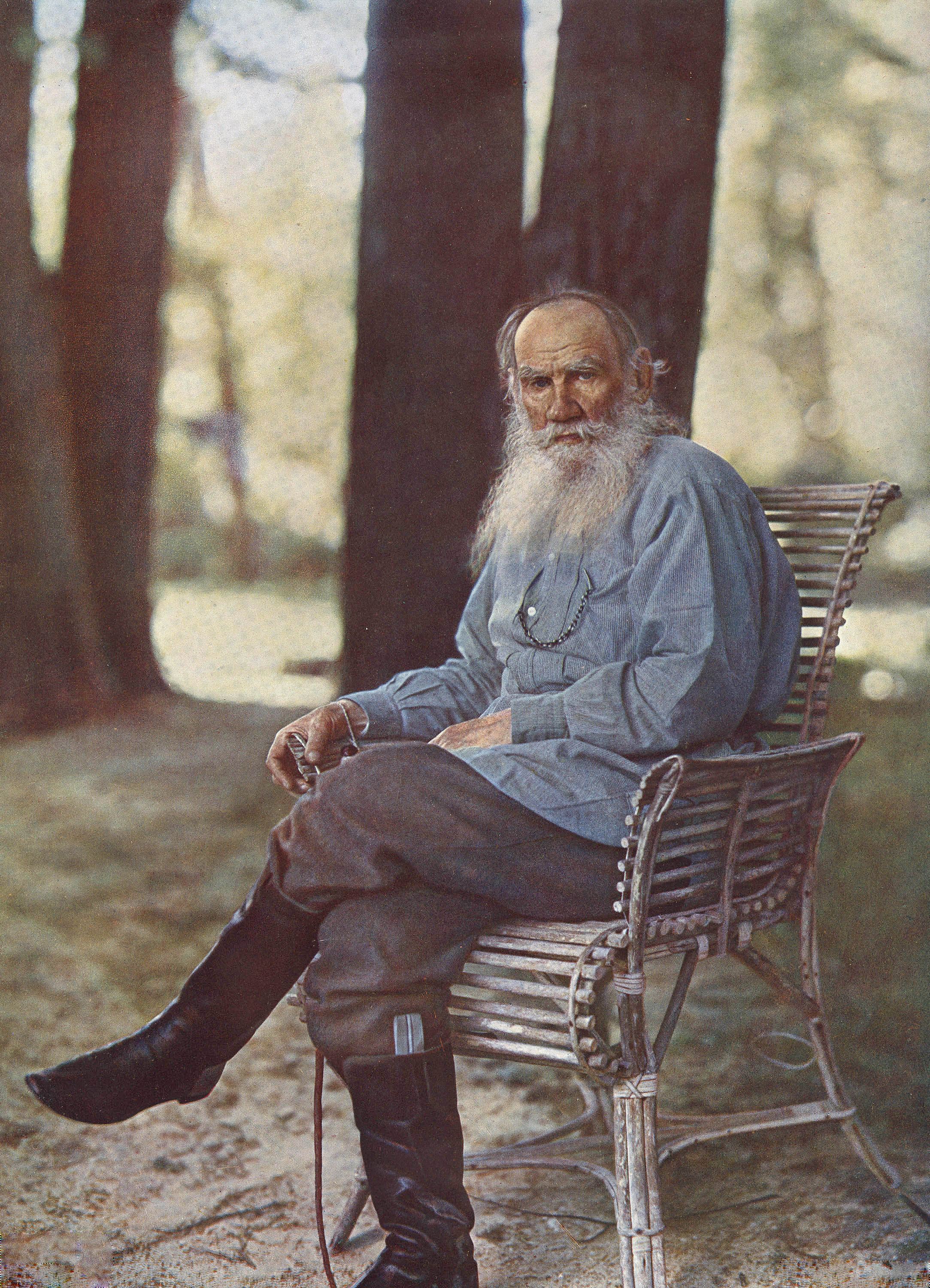
ALYOSHA was the younger brother. He was called the Pot, because his mother had once sent him with a pot of milk to the deacon’s wife, and he had stumbled against something and broken it. His mother had beaten him, and the children had teased him. Since then he was nicknamed the Pot. Alyosha was a tiny, thin little fellow, with ears like wings, and a huge nose. “Alyosha has a nose that looks like a dog on a hill!” the children used to call after him. Alyosha went to the village school, but was not good at lessons; besides, there was so little time to learn. His elder brother was in town, working for a merchant, so Alyosha had to help his father from a very early age. When he was no more than six he used to go out with the girls to watch the cows and sheep in the pasture, and a little later he looked after the horses by day and by night. And at twelve years of age he had already begun to plough and to drive the cart. The skill was there though the strength was not. He was always cheerful. Whenever the children made fun of him, he would either laugh or be silent. When his father scolded him he would stand mute and listen attentively, and as soon as the scolding was over would smile and go on with his work. Alyosha was nineteen when his brother was taken as a soldier. So his father placed him with the merchant as a yard-porter. He was given his brother’s old boots, his father’s old coat and cap, and was taken to town. Alyosha was delighted with his clothes, but the merchant was not impressed by his appearance.
“I thought you would bring me a man in Simeon’s place,” he said, scanning Alyosha; “and you’ve brought me THIS! What’s the good of him?”
“He can do everything; look after horses and drive. He’s a good one to work. He looks rather thin, but he’s tough enough. And he’s very willing.”
“He looks it. All right; we’ll see what we can do with him.”
So Alyosha remained at the merchant’s.
The family was not a large one. It consisted of the merchant’s wife: her old mother: a married son poorly educated who was in his father’s business: another son, a learned one who had finished school and entered the University, but having been expelled, was living at home: and a daughter who still went to school.
They did not take to Alyosha at first. He was uncouth, badly dressed, and had no manner, but they soon got used to him. Alyosha worked even better than his brother had done; he was really very willing. They sent him on all sorts of errands, but he did everything quickly and readily, going from one task to another without stopping. And so here, just as at home, all the work was put upon his shoulders. The more he did, the more he was given to do. His mistress, her old mother, the son, the daughter, the clerk, and the cook—all ordered him about, and sent him from one place to another.
“Alyosha, do this! Alyosha, do that! What! have you forgotten, Alyosha? Mind you don’t forget, Alyosha!” was heard from morning till night. And Alyosha ran here, looked after this and that, forgot nothing, found time for everything, and was always cheerful.
His brother’s old boots were soon worn out, and his master scolded him for going about in tatters with his toes sticking out. He ordered another pair to be bought for him in the market. Alyosha was delighted with his new boots, but was angry with his feet when they ached at the end of the day after so much running about. And then he was afraid that his father would be annoyed when he came to town for his wages, to find that his master had deducted the cost of the boots.
In the winter Alyosha used to get up before daybreak. He would chop the wood, sweep the yard, feed the cows and horses, light the stoves, clean the boots, prepare the samovars and polish them afterwards; or the clerk would get him to bring up the goods; or the cook would set him to knead the bread and clean the saucepans. Then he was sent to town on various errands, to bring the daughter home from school, or to get some olive oil for the old mother. “Why the devil have you been so long?” first one, then another, would say to him. Why should they go? Alyosha can go. “Alyosha! Alyosha!” And Alyosha ran here and there. He breakfasted in snatches while he was working, and rarely managed to get his dinner at the proper hour. The cook used to scold him for being late, but she was sorry for him all the same, and would keep something hot for his dinner and supper.
At holiday times there was more work than ever, but Alyosha liked holidays because everybody gave him a tip. Not much certainly, but it would amount up to about sixty kopeks [1s 2d]—his very own money. For Alyosha never set eyes on his wages. His father used to come and take them from the merchant, and only scold Alyosha for wearing out his boots.
When he had saved up two roubles [4s], by the advice of the cook he bought himself a red knitted jacket, and was so happy when he put it on, that he couldn’t close his mouth for joy. Alyosha was not talkative; when he spoke at all, he spoke abruptly, with his head turned away. When told to do anything, or asked if he could do it, he would say yes without the smallest hesitation, and set to work at once.
Alyosha did not know any prayer; and had forgotten what his mother had taught him. But he prayed just the same, every morning and every evening, prayed with his hands, crossing himself.
He lived like this for about a year and a half, and towards the end of the second year a most startling thing happened to him. He discovered one day, to his great surprise, that, in addition to the relation of usefulness existing between people, there was also another, a peculiar relation of quite a different character. Instead of a man being wanted to clean boots, and go on errands and harness horses, he is not wanted to be of any service at all, but another human being wants to serve him and pet him. Suddenly Alyosha felt he was such a man.
He made this discovery through the cook Ustinia. She was young, had no parents, and worked as hard as Alyosha. He felt for the first time in his life that he—not his services, but he himself—was necessary to another human being. When his mother used to be sorry for him, he had taken no notice of her. It had seemed to him quite natural, as though he were feeling sorry for himself. But here was Ustinia, a perfect stranger, and sorry for him. She would save him some hot porridge, and sit watching him, her chin propped on her bare arm, with the sleeve rolled up, while he was eating it. When he looked at her she would begin to laugh, and he would laugh too.
This was such a new, strange thing to him that it frightened Alyosha. He feared that it might interfere with his work. But he was pleased, nevertheless, and when he glanced at the trousers that Ustinia had mended for him, he would shake his head and smile. He would often think of her while at work, or when running on errands. “A fine girl, Ustinia!” he sometimes exclaimed.
Ustinia used to help him whenever she could, and he helped her. She told him all about her life; how she had lost her parents; how her aunt had taken her in and found a place for her in the town; how the merchant’s son had tried to take liberties with her, and how she had rebuffed him. She liked to talk, and Alyosha liked to listen to her. He had heard that peasants who came up to work in the towns frequently got married to servant girls. On one occasion she asked him if his parents intended marrying him soon. He said that he did not know; that he did not want to marry any of the village girls.
“Have you taken a fancy to some one, then?”
“I would marry you, if you’d be willing.”
“Get along with you, Alyosha the Pot; but you’ve found your tongue, haven’t you?” she exclaimed, slapping him on the back with a towel she held in her hand. “Why shouldn’t I?”
At Shrovetide Alyosha’s father came to town for his wages. It had come to the ears of the merchant’s wife that Alyosha wanted to marry Ustinia, and she disapproved of it. “What will be the use of her with a baby?” she thought, and informed her husband.
The merchant gave the old man Alyosha’s wages.
“How is my lad getting on?” he asked. “I told you he was willing.”
“That’s all right, as far as it goes, but he’s taken some sort of nonsense into his head. He wants to marry our cook. Now I don’t approve of married servants. We won’t have them in the house.”
“Well, now, who would have thought the fool would think of such a thing?” the old man exclaimed. “But don’t you worry. I’ll soon settle that.”
He went into the kitchen, and sat down at the table waiting for his son. Alyosha was out on an errand, and came back breathless.
“I thought you had some sense in you; but what’s this you’ve taken into your head?” his father began.
“I? Nothing.”
“How, nothing? They tell me you want to get married. You shall get married when the time comes. I’ll find you a decent wife, not some town hussy.”
His father talked and talked, while Alyosha stood still and sighed. When his father had quite finished, Alyosha smiled.
“All right. I’ll drop it.”
“Now that’s what I call sense.”
When he was left alone with Ustinia he told her what his father had said. (She had listened at the door.)
“It’s no good; it can’t come off. Did you hear? He was angry—won’t have it at any price.”
Ustinia cried into her apron.
Alyosha shook his head.
“What’s to be done? We must do as we’re told.”
“Well, are you going to give up that nonsense, as your father told you?” his mistress asked, as he was putting up the shutters in the evening.
“To be sure we are,” Alyosha replied with a smile, and then burst into tears.
From that day Alyosha went about his work as usual, and no longer talked to Ustinia about their getting married. One day in Lent the clerk told him to clear the snow from the roof. Alyosha climbed on to the roof and swept away all the snow; and, while he was still raking out some frozen lumps from the gutter, his foot slipped and he fell over. Unfortunately he did not fall on the snow, but on a piece of iron over the door. Ustinia came running up, together with the merchant’s daughter.
“Have you hurt yourself, Alyosha?”
“Ah! no, it’s nothing.”
But he could not raise himself when he tried to, and began to smile.
He was taken into the lodge. The doctor arrived, examined him, and asked where he felt the pain.
“I feel it all over,” he said. “But it doesn’t matter. I’m only afraid master will be annoyed. Father ought to be told.”
Alyosha lay in bed for two days, and on the third day they sent for the priest.
“Are you really going to die?” Ustinia asked.
“Of course I am. You can’t go on living for ever. You must go when the time comes.” Alyosha spoke rapidly as usual. “Thank you, Ustinia. You’ve been very good to me. What a lucky thing they didn’t let us marry! Where should we have been now? It’s much better as it is.”
When the priest came, he prayed with his hands and with his heart. “As it is good here when you obey and do no harm to others, so it will be there,” was the thought within it.
He spoke very little; he only said he was thirsty, and he seemed full of wonder at something.
He lay in wonderment, then stretched himself, and died.
MY DREAM
“As a daughter she no longer exists for me. Can’t you understand? She simply doesn’t exist. Still, I cannot possibly leave her to the charity of strangers. I will arrange things so that she can live as she pleases, but I do not wish to hear of her. Who would ever have thought … the horror of it, the horror of it.”
He shrugged his shoulders, shook his head, and raised his eyes. These words were spoken by Prince Michael Ivanovich to his brother Peter, who was governor of a province in Central Russia. Prince Peter was a man of fifty, Michael’s junior by ten years.
On discovering that his daughter, who had left his house a year before, had settled here with her child, the elder brother had come from St. Petersburg to the provincial town, where the above conversation took place.
Prince Michael Ivanovich was a tall, handsome, white-haired, fresh coloured man, proud and attractive in appearance and bearing. His family consisted of a vulgar, irritable wife, who wrangled with him continually over every petty detail, a son, a ne’er-do-well, spendthrift and roue—yet a “gentleman,” according to his father’s code, two daughters, of whom the elder had married well, and was living in St. Petersburg; and the younger, Lisa—his favourite, who had disappeared from home a year before. Only a short while ago he had found her with her child in this provincial town.
Prince Peter wanted to ask his brother how, and under what circumstances, Lisa had left home, and who could possibly be the father of her child. But he could not make up his mind to inquire.
That very morning, when his wife had attempted to condole with her brother-in-law, Prince Peter had observed a look of pain on his brother’s face. The look had at once been masked by an expression of unapproachable pride, and he had begun to question her about their flat, and the price she paid. At luncheon, before the family and guests, he had been witty and sarcastic as usual. Towards every one, excepting the children, whom he treated with almost reverent tenderness, he adopted an attitude of distant hauteur. And yet it was so natural to him that every one somehow acknowledged his right to be haughty.
In the evening his brother arranged a game of whist. When he retired to the room which had been made ready for him, and was just beginning to take out his artificial teeth, some one tapped lightly on the door with two fingers.
“Who is that?”
“C’est moi, Michael.”
Prince Michael Ivanovich recognised the voice of his sister-in-law, frowned, replaced his teeth, and said to himself, “What does she want?” Aloud he said, “Entrez.”
His sister-in-law was a quiet, gentle creature, who bowed in submission to her husband’s will. But to many she seemed a crank, and some did not hesitate to call her a fool. She was pretty, but her hair was always carelessly dressed, and she herself was untidy and absent-minded. She had, also, the strangest, most unaristocratic ideas, by no means fitting in the wife of a high official. These ideas she would express most unexpectedly, to everybody’s astonishment, her husband’s no less than her friends’.
“Fous pouvez me renvoyer, mais je ne m’en irai pas, je vous le dis d’avance,” she began, in her characteristic, indifferent way.
“Dieu preserve,” answered her brother-in-law, with his usual somewhat exaggerated politeness, and brought forward a chair for her.
“Ca ne vous derange pas?” she asked, taking out a cigarette. “I’m not going to say anything unpleasant, Michael. I only wanted to say something about Lisochka.”
Michael Ivanovich sighed—the word pained him; but mastering himself at once, he answered with a tired smile. “Our conversation can only be on one subject, and that is the subject you wish to discuss.” He spoke without looking at her, and avoided even naming the subject. But his plump, pretty little sister-in-law was unabashed. She continued to regard him with the same gentle, imploring look in her blue eyes, sighing even more deeply.
“Michael, mon bon ami, have pity on her. She is only human.”
“I never doubted that,” said Michael Ivanovich with a bitter smile.
“She is your daughter.”
“She was—but my dear Aline, why talk about this?”
“Michael, dear, won’t you see her? I only wanted to say, that the one who is to blame—”
Prince Michael Ivanovich flushed; his face became cruel.
“For heaven’s sake, let us stop. I have suffered enough. I have now but one desire, and that is to put her in such a position that she will be independent of others, and that she shall have no further need of communicating with me. Then she can live her own life, and my family and I need know nothing more about her. That is all I can do.”
“Michael, you say nothing but ‘I’! She, too, is ‘I.’”
“No doubt; but, dear Aline, please let us drop the matter. I feel it too deeply.”
Alexandra Dmitrievna remained silent for a few moments, shaking her head. “And Masha, your wife, thinks as you do?”
“Yes, quite.”
Alexandra Dmitrievna made an inarticulate sound.
“Brisons la dessus et bonne nuit,” said he. But she did not go. She stood silent a moment. Then,—“Peter tells me you intend to leave the money with the woman where she lives. Have you the address?”
“I have.”
“Don’t leave it with the woman, Michael! Go yourself. Just see how she lives. If you don’t want to see her, you need not. HE isn’t there; there is no one there.”
Michael Ivanovich shuddered violently.
“Why do you torture me so? It’s a sin against hospitality!”
Alexandra Dmitrievna rose, and almost in tears, being touched by her own pleading, said, “She is so miserable, but she is such a dear.”
He got up, and stood waiting for her to finish. She held out her hand.
“Michael, you do wrong,” said she, and left him.
For a long while after she had gone Michael Ivanovich walked to and fro on the square of carpet. He frowned and shivered, and exclaimed, “Oh, oh!” And then the sound of his own voice frightened him, and he was silent.
His wounded pride tortured him. His daughter—his—brought up in the house of her mother, the famous Avdotia Borisovna, whom the Empress honoured with her visits, and acquaintance with whom was an honour for all the world! His daughter—; and he had lived his life as a knight of old, knowing neither fear nor blame. The fact that he had a natural son born of a Frenchwoman, whom he had settled abroad, did not lower his own self-esteem. And now this daughter, for whom he had not only done everything that a father could and should do; this daughter to whom he had given a splendid education and every opportunity to make a match in the best Russian society—this daughter to whom he had not only given all that a girl could desire, but whom he had really LOVED; whom he had admired, been proud of—this daughter had repaid him with such disgrace, that he was ashamed and could not face the eyes of men!
He recalled the time when she was not merely his child, and a member of his family, but his darling, his joy and his pride. He saw her again, a little thing of eight or nine, bright, intelligent, lively, impetuous, graceful, with brilliant black eyes and flowing auburn hair. He remembered how she used to jump up on his knees and hug him, and tickle his neck; and how she would laugh, regardless of his protests, and continue to tickle him, and kiss his lips, his eyes, and his cheeks. He was naturally opposed to all demonstration, but this impetuous love moved him, and he often submitted to her petting. He remembered also how sweet it was to caress her. To remember all this, when that sweet child had become what she now was, a creature of whom he could not think without loathing.
He also recalled the time when she was growing into womanhood, and the curious feeling of fear and anger that he experienced when he became aware that men regarded her as a woman. He thought of his jealous love when she came coquettishly to him dressed for a ball, and knowing that she was pretty. He dreaded the passionate glances which fell upon her, that she not only did not understand but rejoiced in. “Yes,” thought he, “that superstition of woman’s purity! Quite the contrary, they do not know shame—they lack this sense.” He remembered how, quite inexplicably to him, she had refused two very good suitors. She had become more and more fascinated by her own success in the round of gaieties she lived in.
But this success could not last long. A year passed, then two, then three. She was a familiar figure, beautiful—but her first youth had passed, and she had become somehow part of the ball-room furniture. Michael Ivanovich remembered how he had realised that she was on the road to spinsterhood, and desired but one thing for her. He must get her married off as quickly as possible, perhaps not quite so well as might have been arranged earlier, but still a respectable match.
But it seemed to him she had behaved with a pride that bordered on insolence. Remembering this, his anger rose more and more fiercely against her. To think of her refusing so many decent men, only to end in this disgrace. “Oh, oh!” he groaned again.
Then stopping, he lit a cigarette, and tried to think of other things. He would send her money, without ever letting her see him. But memories came again. He remembered—it was not so very long ago, for she was more than twenty then—her beginning a flirtation with a boy of fourteen, a cadet of the Corps of Pages who had been staying with them in the country. She had driven the boy half crazy; he had wept in his distraction. Then how she had rebuked her father severely, coldly, and even rudely, when, to put an end to this stupid affair, he had sent the boy away. She seemed somehow to consider herself insulted. Since then father and daughter had drifted into undisguised hostility.
“I was right,” he said to himself. “She is a wicked and shameless woman.”
And then, as a last ghastly memory, there was the letter from Moscow, in which she wrote that she could not return home; that she was a miserable, abandoned woman, asking only to be forgiven and forgotten. Then the horrid recollection of the scene with his wife came to him; their surmises and their suspicions, which became a certainty. The calamity had happened in Finland, where they had let her visit her aunt; and the culprit was an insignificant Swede, a student, an empty-headed, worthless creature—and married.
All this came back to him now as he paced backwards and forwards on the bedroom carpet, recollecting his former love for her, his pride in her. He recoiled with terror before the incomprehensible fact of her downfall, and he hated her for the agony she was causing him. He remembered the conversation with his sister-in-law, and tried to imagine how he might forgive her. But as soon as the thought of “him” arose, there surged up in his heart horror, disgust, and wounded pride. He groaned aloud, and tried to think of something else.
“No, it is impossible; I will hand over the money to Peter to give her monthly. And as for me, I have no longer a daughter.”
And again a curious feeling overpowered him: a mixture of self-pity at the recollection of his love for her, and of fury against her for causing him this anguish.
DURING the last year Lisa had without doubt lived through more than in all the preceding twenty-five. Suddenly she had realised the emptiness of her whole life. It rose before her, base and sordid—this life at home and among the rich set in St. Petersburg—this animal existence that never sounded the depths, but only touched the shallows of life.
It was well enough for a year or two, or perhaps even three. But when it went on for seven or eight years, with its parties, balls, concerts, and suppers; with its costumes and coiffures to display the charms of the body; with its adorers old and young, all alike seemingly possessed of some unaccountable right to have everything, to laugh at everything; and with its summer months spent in the same way, everything yielding but a superficial pleasure, even music and reading merely touching upon life’s problems, but never solving them—all this holding out no promise of change, and losing its charm more and more—she began to despair. She had desperate moods when she longed to die.
Her friends directed her thoughts to charity. On the one hand, she saw poverty which was real and repulsive, and a sham poverty even more repulsive and pitiable; on the other, she saw the terrible indifference of the lady patronesses who came in carriages and gowns worth thousands. Life became to her more and more unbearable. She yearned for something real, for life itself—not this playing at living, not this skimming life of its cream. Of real life there was none. The best of her memories was her love for the little cadet Koko. That had been a good, honest, straight-forward impulse, and now there was nothing like it. There could not be. She grew more and more depressed, and in this gloomy mood she went to visit an aunt in Finland. The fresh scenery and surroundings, the people strangely different to her own, appealed to her at any rate as a new experience.
How and when it all began she could not clearly remember. Her aunt had another guest, a Swede. He talked of his work, his people, the latest Swedish novel. Somehow, she herself did not know how that terrible fascination of glances and smiles began, the meaning of which cannot be put into words.
These smiles and glances seemed to reveal to each, not only the soul of the other, but some vital and universal mystery. Every word they spoke was invested by these smiles with a profound and wonderful significance. Music, too, when they were listening together, or when they sang duets, became full of the same deep meaning. So, also, the words in the books they read aloud. Sometimes they would argue, but the moment their eyes met, or a smile flashed between them, the discussion remained far behind. They soared beyond it to some higher plane consecrated to themselves.
How it had come about, how and when the devil, who had seized hold of them both, first appeared behind these smiles and glances, she could not say. But, when terror first seized her, the invisible threads that bound them were already so interwoven that she had no power to tear herself free. She could only count on him and on his honour. She hoped that he would not make use of his power; yet all the while she vaguely desired it.
Her weakness was the greater, because she had nothing to support her in the struggle. She was weary of society life and she had no affection for her mother. Her father, so she thought, had cast her away from him, and she longed passionately to live and to have done with play. Love, the perfect love of a woman for a man, held the promise of life for her. Her strong, passionate nature, too, was dragging her thither. In the tall, strong figure of this man, with his fair hair and light upturned moustache, under which shone a smile attractive and compelling, she saw the promise of that life for which she longed. And then the smiles and glances, the hope of something so incredibly beautiful, led, as they were bound to lead, to that which she feared but unconsciously awaited.
Suddenly all that was beautiful, joyous, spiritual, and full of promise for the future, became animal and sordid, sad and despairing.
She looked into his eyes and tried to smile, pretending that she feared nothing, that everything was as it should be; but deep down in her soul she knew it was all over. She understood that she had not found in him what she had sought; that which she had once known in herself and in Koko. She told him that he must write to her father asking her hand in marriage. This he promised to do; but when she met him next he said it was impossible for him to write just then. She saw something vague and furtive in his eyes, and her distrust of him grew. The following day he wrote to her, telling her that he was already married, though his wife had left him long since; that he knew she would despise him for the wrong he had done her, and implored her forgiveness. She made him come to see her. She said she loved him; that she felt herself bound to him for ever whether he was married or not, and would never leave him. The next time they met he told her that he and his parents were so poor that he could only offer her the meanest existence. She answered that she needed nothing, and was ready to go with him at once wherever he wished. He endeavoured to dissuade her, advising her to wait; and so she waited. But to live on with this secret, with occasional meetings, and merely corresponding with him, all hidden from her family, was agonising, and she insisted again that he must take her away. At first, when she returned to St. Petersburg, he wrote promising to come, and then letters ceased and she knew no more of him.
She tried to lead her old life, but it was impossible. She fell ill, and the efforts of the doctors were unavailing; in her hopelessness she resolved to kill herself. But how was she to do this, so that her death might seem natural? She really desired to take her life, and imagined that she had irrevocably decided on the step. So, obtaining some poison, she poured it into a glass, and in another instant would have drunk it, had not her sister’s little son of five at that very moment run in to show her a toy his grandmother had given him. She caressed the child, and, suddenly stopping short, burst into tears.
The thought overpowered her that she, too, might have been a mother had he not been married, and this vision of motherhood made her look into her own soul for the first time. She began to think not of what others would say of her, but of her own life. To kill oneself because of what the world might say was easy; but the moment she saw her own life dissociated from the world, to take that life was out of the question. She threw away the poison, and ceased to think of suicide.
Then her life within began. It was real life, and despite the torture of it, had the possibility been given her, she would not have turned back from it. She began to pray, but there was no comfort in prayer; and her suffering was less for herself than for her father, whose grief she foresaw and understood.
Thus months dragged along, and then something happened which entirely transformed her life. One day, when she was at work upon a quilt, she suddenly experienced a strange sensation. No—it seemed impossible. Motionless she sat with her work in hand. Was it possible that this was IT. Forgetting everything, his baseness and deceit, her mother’s querulousness, and her father’s sorrow, she smiled. She shuddered at the recollection that she was on the point of killing it, together with herself.
She now directed all her thoughts to getting away—somewhere where she could bear her child—and become a miserable, pitiful mother, but a mother withal. Somehow she planned and arranged it all, leaving her home and settling in a distant provincial town, where no one could find her, and where she thought she would be far from her people. But, unfortunately, her father’s brother received an appointment there, a thing she could not possibly foresee. For four months she had been living in the house of a midwife—one Maria Ivanovna; and, on learning that her uncle had come to the town, she was preparing to fly to a still remoter hiding-place.
MICHAEL IVANOVICH awoke early next morning. He entered his brother’s study, and handed him the cheque, filled in for a sum which he asked him to pay in monthly instalments to his daughter. He inquired when the express left for St. Petersburg. The train left at seven in the evening, giving him time for an early dinner before leaving. He breakfasted with his sister-in-law, who refrained from mentioning the subject which was so painful to him, but only looked at him timidly; and after breakfast he went out for his regular morning walk.
Alexandra Dmitrievna followed him into the hall.
“Go into the public gardens, Michael—it is very charming there, and quite near to Everything,” said she, meeting his sombre looks with a pathetic glance.
Michael Ivanovich followed her advice and went to the public gardens, which were so near to Everything, and meditated with annoyance on the stupidity, the obstinacy, and heartlessness of women.
“She is not in the very least sorry for me,” he thought of his sister-in-law. “She cannot even understand my sorrow. And what of her?” He was thinking of his daughter. “She knows what all this means to me—the torture. What a blow in one’s old age! My days will be shortened by it! But I’d rather have it over than endure this agony. And all that ‘pour les beaux yeux d’un chenapan’—oh!” he moaned; and a wave of hatred and fury arose in him as he thought of what would be said in the town when every one knew. (And no doubt every one knew already.) Such a feeling of rage possessed him that he would have liked to beat it into her head, and make her understand what she had done. These women never understand. “It is quite near Everything,” suddenly came to his mind, and getting out his notebook, he found her address. Vera Ivanovna Silvestrova, Kukonskaya Street, Abromov’s house. She was living under this name. He left the gardens and called a cab.
“Whom do you wish to see, sir?” asked the midwife, Maria Ivanovna, when he stepped on the narrow landing of the steep, stuffy staircase.
“Does Madame Silvestrova live here?”
“Vera Ivanovna? Yes; please come in. She has gone out; she’s gone to the shop round the corner. But she’ll be back in a minute.”
Michael Ivanovich followed the stout figure of Maria Ivanovna into a tiny parlour, and from the next room came the screams of a baby, sounding cross and peevish, which filled him with disgust. They cut him like a knife.
Maria Ivanovna apologised, and went into the room, and he could hear her soothing the child. The child became quiet, and she returned.
“That is her baby; she’ll be back in a minute. You are a friend of hers, I suppose?”
“Yes—a friend—but I think I had better come back later on,” said Michael Ivanovich, preparing to go. It was too unbearable, this preparation to meet her, and any explanation seemed impossible.
He had just turned to leave, when he heard quick, light steps on the stairs, and he recognised Lisa’s voice.
“Maria Ivanovna—has he been crying while I’ve been gone—I was—”
Then she saw her father. The parcel she was carrying fell from her hands.
“Father!” she cried, and stopped in the doorway, white and trembling.
He remained motionless, staring at her. She had grown so thin. Her eyes were larger, her nose sharper, her hands worn and bony. He neither knew what to do, nor what to say. He forgot all his grief about his dishonour. He only felt sorrow, infinite sorrow for her; sorrow for her thinness, and for her miserable rough clothing; and most of all, for her pitiful face and imploring eyes.
“Father—forgive,” she said, moving towards him.
“Forgive—forgive me,” he murmured; and he began to sob like a child, kissing her face and hands, and wetting them with his tears.
In his pity for her he understood himself. And when he saw himself as he was, he realised how he had wronged her, how guilty he had been in his pride, in his coldness, even in his anger towards her. He was glad that it was he who was guilty, and that he had nothing to forgive, but that he himself needed forgiveness. She took him to her tiny room, and told him how she lived; but she did not show him the child, nor did she mention the past, knowing how painful it would be to him.
He told her that she must live differently.
“Yes; if I could only live in the country,” said she.
“We will talk it over,” he said. Suddenly the child began to wail and to scream. She opened her eyes very wide; and, not taking them from her father’s face, remained hesitating and motionless.
“Well—I suppose you must feed him,” said Michael Ivanovich, and frowned with the obvious effort.
She got up, and suddenly the wild idea seized her to show him whom she loved so deeply the thing she now loved best of all in the world. But first she looked at her father’s face. Would he be angry or not? His face revealed no anger, only suffering.
“Yes, go, go,” said he; “God bless you. Yes. I’ll come again to-morrow, and we will decide. Good-bye, my darling—good-bye.” Again he found it hard to swallow the lump in his throat.
When Michael Ivanovich returned to his brother’s house, Alexandra Dmitrievna immediately rushed to him.
“Well?”
“Well? Nothing.”
“Have you seen?” she asked, guessing from his expression that something had happened.
“Yes,” he answered shortly, and began to cry. “I’m getting old and stupid,” said he, mastering his emotion.
“No; you are growing wise—very wise.”
THERE ARE NO GUILTY PEOPLE
MINE is a strange and wonderful lot! The chances are that there is not a single wretched beggar suffering under the luxury and oppression of the rich who feels anything like as keenly as I do either the injustice, the cruelty, and the horror of their oppression of and contempt for the poor; or the grinding humiliation and misery which befall the great majority of the workers, the real producers of all that makes life possible. I have felt this for a long time, and as the years have passed by the feeling has grown and grown, until recently it reached its climax. Although I feel all this so vividly, I still live on amid the depravity and sins of rich society; and I cannot leave it, because I have neither the knowledge nor the strength to do so. I cannot. I do not know how to change my life so that my physical needs—food, sleep, clothing, my going to and fro—may be satisfied without a sense of shame and wrongdoing in the position which I fill.
There was a time when I tried to change my position, which was not in harmony with my conscience; but the conditions created by the past, by my family and its claims upon me, were so complicated that they would not let me out of their grasp, or rather, I did not know how to free myself. I had not the strength. Now that I am over eighty and have become feeble, I have given up trying to free myself; and, strange to say, as my feebleness increases I realise more and more strongly the wrongfulness of my position, and it grows more and more intolerable to me.
It has occurred to me that I do not occupy this position for nothing: that Providence intended that I should lay bare the truth of my feelings, so that I might atone for all that causes my suffering, and might perhaps open the eyes of those—or at least of some of those—who are still blind to what I see so clearly, and thus might lighten the burden of that vast majority who, under existing conditions, are subjected to bodily and spiritual suffering by those who deceive them and also deceive themselves. Indeed, it may be that the position which I occupy gives me special facilities for revealing the artificial and criminal relations which exist between men—for telling the whole truth in regard to that position without confusing the issue by attempting to vindicate myself, and without rousing the envy of the rich and feelings of oppression in the hearts of the poor and downtrodden. I am so placed that I not only have no desire to vindicate myself; but, on the contrary, I find it necessary to make an effort lest I should exaggerate the wickedness of the great among whom I live, of whose society I am ashamed, whose attitude towards their fellow-men I detest with my whole soul, though I find it impossible to separate my lot from theirs. But I must also avoid the error of those democrats and others who, in defending the oppressed and the enslaved, do not see their failings and mistakes, and who do not make sufficient allowance for the difficulties created, the mistakes inherited from the past, which in a degree lessens the responsibility of the upper classes.
Free from desire for self-vindication, free from fear of an emancipated people, free from that envy and hatred which the oppressed feel for their oppressors, I am in the best possible position to see the truth and to tell it. Perhaps that is why Providence placed me in such a position. I will do my best to turn it to account.
Alexander Ivanovich Volgin, a bachelor and a clerk in a Moscow bank at a salary of eight thousand roubles a year, a man much respected in his own set, was staying in a country-house. His host was a wealthy landowner, owning some twenty-five hundred acres, and had married his guest’s cousin. Volgin, tired after an evening spent in playing vint* for small stakes with [* A game of cards similar to auction bridge.] members of the family, went to his room and placed his watch, silver cigarette-case, pocket-book, big leather purse, and pocket-brush and comb on a small table covered with a white cloth, and then, taking off his coat, waistcoat, shirt, trousers, and underclothes, his silk socks and English boots, put on his nightshirt and dressing-gown. His watch pointed to midnight. Volgin smoked a cigarette, lay on his face for about five minutes reviewing the day’s impressions; then, blowing out his candle, he turned over on his side and fell asleep about one o’clock, in spite of a good deal of restlessness. Awaking next morning at eight he put on his slippers and dressing-gown, and rang the bell.
The old butler, Stephen, the father of a family and the grandfather of six grandchildren, who had served in that house for thirty years, entered the room hurriedly, with bent legs, carrying in the newly blackened boots which Volgin had taken off the night before, a well-brushed suit, and a clean shirt. The guest thanked him, and then asked what the weather was like (the blinds were drawn so that the sun should not prevent any one from sleeping till eleven o’clock if he were so inclined), and whether his hosts had slept well. He glanced at his watch—it was still early—and began to wash and dress. His water was ready, and everything on the washing-stand and dressing-table was ready for use and properly laid out—his soap, his tooth and hair brushes, his nail scissors and files. He washed his hands and face in a leisurely fashion, cleaned and manicured his nails, pushed back the skin with the towel, and sponged his stout white body from head to foot. Then he began to brush his hair. Standing in front of the mirror, he first brushed his curly beard, which was beginning to turn grey, with two English brushes, parting it down the middle. Then he combed his hair, which was already showing signs of getting thin, with a large tortoise-shell comb. Putting on his underlinen, his socks, his boots, his trousers—which were held up by elegant braces—and his waistcoat, he sat down coatless in an easy chair to rest after dressing, lit a cigarette, and began to think where he should go for a walk that morning—to the park or to Littleports (what a funny name for a wood!). He thought he would go to Littleports. Then he must answer Simon Nicholaevich’s letter; but there was time enough for that. Getting up with an air of resolution, he took out his watch. It was already five minutes to nine. He put his watch into his waistcoat pocket, and his purse—with all that was left of the hundred and eighty roubles he had taken for his journey, and for the incidental expenses of his fortnight’s stay with his cousin—and then he placed into his trouser pocket his cigarette-case and electric cigarette-lighter, and two clean handkerchiefs into his coat pockets, and went out of the room, leaving as usual the mess and confusion which he had made to be cleared up by Stephen, an old man of over fifty. Stephen expected Volgin to “remunerate” him, as he said, being so accustomed to the work that he did not feel the slightest repugnance for it. Glancing at a mirror, and feeling satisfied with his appearance, Volgin went into the dining-room.
There, thanks to the efforts of the housekeeper, the footman, and under-butler—the latter had risen at dawn in order to run home to sharpen his son’s scythe—breakfast was ready. On a spotless white cloth stood a boiling, shiny, silver samovar (at least it looked like silver), a coffee-pot, hot milk, cream, butter, and all sorts of fancy white bread and biscuits. The only persons at table were the second son of the house, his tutor (a student), and the secretary. The host, who was an active member of the Zemstvo and a great farmer, had already left the house, having gone at eight o’clock to attend to his work. Volgin, while drinking his coffee, talked to the student and the secretary about the weather, and yesterday’s vint, and discussed Theodorite’s peculiar behaviour the night before, as he had been very rude to his father without the slightest cause. Theodorite was the grown-up son of the house, and a ne’er-do-well. His name was Theodore, but some one had once called him Theodorite either as a joke or to tease him; and, as it seemed funny, the name stuck to him, although his doings were no longer in the least amusing. So it was now. He had been to the university, but left it in his second year, and joined a regiment of horse guards; but he gave that up also, and was now living in the country, doing nothing, finding fault, and feeling discontented with everything. Theodorite was still in bed: so were the other members of the household—Anna Mikhailovna, its mistress; her sister, the widow of a general; and a landscape painter who lived with the family.
Volgin took his panama hat from the hall table (it had cost twenty roubles) and his cane with its carved ivory handle, and went out. Crossing the veranda, gay with flowers, he walked through the flower garden, in the centre of which was a raised round bed, with rings of red, white, and blue flowers, and the initials of the mistress of the house done in carpet bedding in the centre. Leaving the flower garden Volgin entered the avenue of lime trees, hundreds of years old, which peasant girls were tidying and sweeping with spades and brooms. The gardener was busy measuring, and a boy was bringing something in a cart. Passing these Volgin went into the park of at least a hundred and twenty-five acres, filled with fine old trees, and intersected by a network of well-kept walks. Smoking as he strolled Volgin took his favourite path past the summer-house into the fields beyond. It was pleasant in the park, but it was still nicer in the fields. On the right some women who were digging potatoes formed a mass of bright red and white colour; on the left were wheat fields, meadows, and grazing cattle; and in the foreground, slightly to the right, were the dark, dark oaks of Littleports. Volgin took a deep breath, and felt glad that he was alive, especially here in his cousin’s home, where he was so thoroughly enjoying the rest from his work at the bank.
“Lucky people to live in the country,” he thought. “True, what with his farming and his Zemstvo, the owner of the estate has very little peace even in the country, but that is his own lookout.” Volgin shook his head, lit another cigarette, and, stepping out firmly with his powerful feet clad in his thick English boots, began to think of the heavy winter’s work in the bank that was in front of him. “I shall be there every day from ten to two, sometimes even till five. And the board meetings … And private interviews with clients… . Then the Duma. Whereas here… . It is delightful. It may be a little dull, but it is not for long.” He smiled. After a stroll in Littleports he turned back, going straight across a fallow field which was being ploughed. A herd of cows, calves, sheep, and pigs, which belonged to the village community, was grazing there. The shortest way to the park was to pass through the herd. He frightened the sheep, which ran away one after another, and were followed by the pigs, of which two little ones stared solemnly at him. The shepherd boy called to the sheep and cracked his whip. “How far behind Europe we are,” thought Volgin, recalling his frequent holidays abroad. “You would not find a single cow like that anywhere in Europe.” Then, wanting to find out where the path which branched off from the one he was on led to and who was the owner of the herd, he called to the boy.
“Whose herd is it?”
The boy was so filled with wonder, verging on terror, when he gazed at the hat, the well-brushed beard, and above all the gold-rimmed eyeglasses, that he could not reply at once. When Volgin repeated his question the boy pulled himself together, and said, “Ours.” “But whose is ‘ours’?” said Volgin, shaking his head and smiling. The boy was wearing shoes of plaited birch bark, bands of linen round his legs, a dirty, unbleached shirt ragged at the shoulder, and a cap the peak of which had been torn.
“Whose is ‘ours’?”
“The Pirogov village herd.”
“How old are you?
“I don’t know.”
“Can you read?”
“No, I can’t.”
“Didn’t you go to school?”
“Yes, I did.”
“Couldn’t you learn to read?”
“No.”
“Where does that path lead?”
The boy told him, and Volgin went on towards the house, thinking how he would chaff Nicholas Petrovich about the deplorable condition of the village schools in spite of all his efforts.
On approaching the house Volgin looked at his watch, and saw that it was already past eleven. He remembered that Nicholas Petrovich was going to drive to the nearest town, and that he had meant to give him a letter to post to Moscow; but the letter was not written. The letter was a very important one to a friend, asking him to bid for him for a picture of the Madonna which was to be offered for sale at an auction. As he reached the house he saw at the door four big, well-fed, well-groomed, thoroughbred horses harnessed to a carriage, the black lacquer of which glistened in the sun. The coachman was seated on the box in a kaftan, with a silver belt, and the horses were jingling their silver bells from time to time.
A bare-headed, barefooted peasant in a ragged kaftan stood at the front door. He bowed. Volgin asked what he wanted.
“I have come to see Nicholas Petrovich.”
“What about?”
“Because I am in distress—my horse has died.”
Volgin began to question him. The peasant told him how he was situated. He had five children, and this had been his only horse. Now it was gone. He wept.
“What are you going to do?”
“To beg.” And he knelt down, and remained kneeling in spite of Volgin’s expostulations.
“What is your name?”
“Mitri Sudarikov,” answered the peasant, still kneeling.
Volgin took three roubles from his purse and gave them to the peasant, who showed his gratitude by touching the ground with his forehead, and then went into the house. His host was standing in the hall.
“Where is your letter?” he asked, approaching Volgin; “I am just off.”
“I’m awfully sorry, I’ll write it this minute, if you will let me. I forgot all about it. It’s so pleasant here that one can forget anything.”
“All right, but do be quick. The horses have already been standing a quarter of an hour, and the flies are biting viciously. Can you wait, Arsenty?” he asked the coachman.
“Why not?” said the coachman, thinking to himself, “why do they order the horses when they aren’t ready? The rush the grooms and I had—just to stand here and feed the flies.”
“Directly, directly,” Volgin went towards his room, but turned back to ask Nicholas Petrovich about the begging peasant.
“Did you see him?—He’s a drunkard, but still he is to be pitied. Do be quick!”
Volgin got out his case, with all the requisites for writing, wrote the letter, made out a cheque for a hundred and eighty roubles, and, sealing down the envelope, took it to Nicholas Petrovich.
“Good-bye.”
Volgin read the newspapers till luncheon. He only read the Liberal papers: The Russian Gazette, Speech, sometimes The Russian Word—but he would not touch The New Times, to which his host subscribed.
While he was scanning at his ease the political news, the Tsar’s doings, the doings of President, and ministers and decisions in the Duma, and was just about to pass on to the general news, theatres, science, murders and cholera, he heard the luncheon bell ring.
Thanks to the efforts of upwards of ten human beings—counting laundresses, gardeners, cooks, kitchen-maids, butlers and footmen—the table was sumptuously laid for eight, with silver waterjugs, decanters, kvass, wine, mineral waters, cut glass, and fine table linen, while two men-servants were continually hurrying to and fro, bringing in and serving, and then clearing away the hors d’oeuvre and the various hot and cold courses.
The hostess talked incessantly about everything that she had been doing, thinking, and saying; and she evidently considered that everything that she thought, said, or did was perfect, and that it would please every one except those who were fools. Volgin felt and knew that everything she said was stupid, but it would never do to let it be seen, and so he kept up the conversation. Theodorite was glum and silent; the student occasionally exchanged a few words with the widow. Now and again there was a pause in the conversation, and then Theodorite interposed, and every one became miserably depressed. At such moments the hostess ordered some dish that had not been served, and the footman hurried off to the kitchen, or to the housekeeper, and hurried back again. Nobody felt inclined either to talk or to eat. But they all forced themselves to eat and to talk, and so luncheon went on.
The peasant who had been begging because his horse had died was named Mitri Sudarikov. He had spent the whole day before he went to the squire over his dead horse. First of all he went to the knacker, Sanin, who lived in a village near. The knacker was out, but he waited for him, and it was dinner-time when he had finished bargaining over the price of the skin. Then he borrowed a neighbour’s horse to take his own to a field to be buried, as it is forbidden to bury dead animals near a village. Adrian would not lend his horse because he was getting in his potatoes, but Stephen took pity on Mitri and gave way to his persuasion. He even lent a hand in lifting the dead horse into the cart. Mitri tore off the shoes from the forelegs and gave them to his wife. One was broken, but the other one was whole. While he was digging the grave with a spade which was very blunt, the knacker appeared and took off the skin; and the carcass was then thrown into the hole and covered up. Mitri felt tired, and went into Matrena’s hut, where he drank half a bottle of vodka with Sanin to console himself. Then he went home, quarrelled with his wife, and lay down to sleep on the hay. He did not undress, but slept just as he was, with a ragged coat for a coverlet. His wife was in the hut with the girls—there were four of them, and the youngest was only five weeks old. Mitri woke up before dawn as usual. He groaned as the memory of the day before broke in upon him—how the horse had struggled and struggled, and then fallen down. Now there was no horse, and all he had was the price of the skin, four roubles and eighty kopeks. Getting up he arranged the linen bands on his legs, and went through the yard into the hut. His wife was putting straw into the stove with one hand, with the other she was holding a baby girl to her breast, which was hanging out of her dirty chemise.
Mitri crossed himself three times, turning towards the corner in which the ikons hung, and repeated some utterly meaningless words, which he called prayers, to the Trinity and the Virgin, the Creed and our Father.
“Isn’t there any water?”
“The girl’s gone for it. I’ve got some tea. Will you go up to the squire?”
“Yes, I’d better.” The smoke from the stove made him cough. He took a rag off the wooden bench and went into the porch. The girl had just come back with the water. Mitri filled his mouth with water from the pail and squirted it out on his hands, took some more in his mouth to wash his face, dried himself with the rag, then parted and smoothed his curly hair with his fingers and went out. A little girl of about ten, with nothing on but a dirty shirt, came towards him. “Good-morning, Uncle Mitri,” she said; “you are to come and thrash.” “All right, I’ll come,” replied Mitri. He understood that he was expected to return the help given the week before by Kumushkir, a man as poor as he was himself, when he was thrashing his own corn with a horse-driven machine.
“Tell them I’ll come—I’ll come at lunch time. I’ve got to go to Ugrumi.” Mitri went back to the hut, and changing his birch-bark shoes and the linen bands on his legs, started off to see the squire. After he had got three roubles from Volgin, and the same sum from Nicholas Petrovich, he returned to his house, gave the money to his wife, and went to his neighbour’s. The thrashing machine was humming, and the driver was shouting. The lean horses were going slowly round him, straining at their traces. The driver was shouting to them in a monotone, “Now, there, my dears.” Some women were unbinding sheaves, others were raking up the scattered straw and ears, and others again were gathering great armfuls of corn and handing them to the men to feed the machine. The work was in full swing. In the kitchen garden, which Mitri had to pass, a girl, clad only in a long shirt, was digging potatoes which she put into a basket.
“Where’s your grandfather?” asked Mitri. “He’s in the barn.” Mitri went to the barn and set to work at once. The old man of eighty knew of Mitri’s trouble. After greeting him, he gave him his place to feed the machine.
Mitri took off his ragged coat, laid it out of the way near the fence, and then began to work vigorously, raking the corn together and throwing it into the machine. The work went on without interruption until the dinner-hour. The cocks had crowed two or three times, but no one paid any attention to them; not because the workers did not believe them, but because they were scarcely heard for the noise of the work and the talk about it. At last the whistle of the squire’s steam thrasher sounded three miles away, and then the owner came into the barn. He was a straight old man of eighty. “It’s time to stop,” he said; “it’s dinner-time.” Those at work seemed to redouble their efforts. In a moment the straw was cleared away; the grain that had been thrashed was separated from the chaff and brought in, and then the workers went into the hut.
The hut was smoke-begrimed, as its stove had no chimney, but it had been tidied up, and benches stood round the table, making room for all those who had been working, of whom there were nine, not counting the owners. Bread, soup, boiled potatoes, and kvass were placed on the table.
An old one-armed beggar, with a bag slung over his shoulder, came in with a crutch during the meal.
“Peace be to this house. A good appetite to you. For Christ’s sake give me something.”
“God will give it to you,” said the mistress, already an old woman, and the daughter-in-law of the master. “Don’t be angry with us.” An old man, who was still standing near the door, said, “Give him some bread, Martha. How can you?”
“I am only wondering whether we shall have enough.” “Oh, it is wrong, Martha. God tells us to help the poor. Cut him a slice.”
Martha obeyed. The beggar went away. The man in charge of the thrashing-machine got up, said grace, thanked his hosts, and went away to rest.
Mitri did not lie down, but ran to the shop to buy some tobacco. He was longing for a smoke. While he smoked he chatted to a man from Demensk, asking the price of cattle, as he saw that he would not be able to manage without selling a cow. When he returned to the others, they were already back at work again; and so it went on till the evening.
Among these downtrodden, duped, and defrauded men, who are becoming demoralised by overwork, and being gradually done to death by underfeeding, there are men living who consider themselves Christians; and others so enlightened that they feel no further need for Christianity or for any religion, so superior do they appear in their own esteem. And yet their hideous, lazy lives are supported by the degrading, excessive labour of these slaves, not to mention the labour of millions of other slaves, toiling in factories to produce samovars, silver, carriages, machines, and the like for their use. They live among these horrors, seeing them and yet not seeing them, although often kind at heart—old men and women, young men and maidens, mothers and children—poor children who are being vitiated and trained into moral blindness.
Here is a bachelor grown old, the owner of thousands of acres, who has lived a life of idleness, greed, and over-indulgence, who reads The New Times, and is astonished that the government can be so unwise as to permit Jews to enter the university. There is his guest, formerly the governor of a province, now a senator with a big salary, who reads with satisfaction that a congress of lawyers has passed a resolution in favor of capital punishment. Their political enemy, N. P., reads a liberal paper, and cannot understand the blindness of the government in allowing the union of Russian men to exist.
Here is a kind, gentle mother of a little girl reading a story to her about Fox, a dog that lamed some rabbits. And here is this little girl. During her walks she sees other children, barefooted, hungry, hunting for green apples that have fallen from the trees; and, so accustomed is she to the sight, that these children do not seem to her to be children such as she is, but only part of the usual surroundings—the familiar landscape.
Why is this?
THE YOUNG TSAR
THE young Tsar had just ascended the throne. For five weeks he had worked without ceasing, in the way that Tsars are accustomed to work. He had been attending to reports, signing papers, receiving ambassadors and high officials who came to be presented to him, and reviewing troops. He was tired, and as a traveller exhausted by heat and thirst longs for a draught of water and for rest, so he longed for a respite of just one day at least from receptions, from speeches, from parades—a few free hours to spend like an ordinary human being with his young, clever, and beautiful wife, to whom he had been married only a month before.
It was Christmas Eve. The young Tsar had arranged to have a complete rest that evening. The night before he had worked till very late at documents which his ministers of state had left for him to examine. In the morning he was present at the Te Deum, and then at a military service. In the afternoon he received official visitors; and later he had been obliged to listen to the reports of three ministers of state, and had given his assent to many important matters. In his conference with the Minister of Finance he had agreed to an increase of duties on imported goods, which should in the future add many millions to the State revenues. Then he sanctioned the sale of brandy by the Crown in various parts of the country, and signed a decree permitting the sale of alcohol in villages having markets. This was also calculated to increase the principal revenue to the State, which was derived from the sale of spirits. He had also approved of the issuing of a new gold loan required for a financial negotiation. The Minister of justice having reported on the complicated case of the succession of the Baron Snyders, the young Tsar confirmed the decision by his signature; and also approved the new rules relating to the application of Article 1830 of the penal code, providing for the punishment of tramps. In his conference with the Minister of the Interior he ratified the order concerning the collection of taxes in arrears, signed the order settling what measures should be taken in regard to the persecution of religious dissenters, and also one providing for the continuance of martial law in those provinces where it had already been established. With the Minister of War he arranged for the nomination of a new Corps Commander for the raising of recruits, and for punishment of breach of discipline. These things kept him occupied till dinner-time, and even then his freedom was not complete. A number of high officials had been invited to dinner, and he was obliged to talk to them: not in the way he felt disposed to do, but according to what he was expected to say. At last the tiresome dinner was over, and the guests departed.
The young Tsar heaved a sigh of relief, stretched himself and retired to his apartments to take off his uniform with the decorations on it, and to don the jacket he used to wear before his accession to the throne. His young wife had also retired to take off her dinner-dress, remarking that she would join him presently.
When he had passed the row of footmen who were standing erect before him, and reached his room; when he had thrown off his heavy uniform and put on his jacket, the young Tsar felt glad to be free from work; and his heart was filled with a tender emotion which sprang from the consciousness of his freedom, of his joyous, robust young life, and of his love. He threw himself on the sofa, stretched out his legs upon it, leaned his head on his hand, fixed his gaze on the dull glass shade of the lamp, and then a sensation which he had not experienced since his childhood,—the pleasure of going to sleep, and a drowsiness that was irresistible—suddenly came over him.
“My wife will be here presently and will find me asleep. No, I must not go to sleep,” he thought. He let his elbow drop down, laid his cheek in the palm of his hand, made himself comfortable, and was so utterly happy that he only felt a desire not to be aroused from this delightful state.
And then what happens to all of us every day happened to him—he fell asleep without knowing himself when or how. He passed from one state into another without his will having any share in it, without even desiring it, and without regretting the state out of which he had passed. He fell into a heavy sleep which was like death. How long he had slept he did not know, but he was suddenly aroused by the soft touch of a hand upon his shoulder.
“It is my darling, it is she,” he thought. “What a shame to have dozed off!”
But it was not she. Before his eyes, which were wide open and blinking at the light, she, that charming and beautiful creature whom he was expecting, did not stand, but HE stood. Who HE was the young Tsar did not know, but somehow it did not strike him that he was a stranger whom he had never seen before. It seemed as if he had known him for a long time and was fond of him, and as if he trusted him as he would trust himself. He had expected his beloved wife, but in her stead that man whom he had never seen before had come. Yet to the young Tsar, who was far from feeling regret or astonishment, it seemed not only a most natural, but also a necessary thing to happen.
“Come!” said the stranger.
“Yes, let us go,” said the young Tsar, not knowing where he was to go, but quite aware that he could not help submitting to the command of the stranger. “But how shall we go?” he asked.
“In this way.”
The stranger laid his hand on the Tsar’s head, and the Tsar for a moment lost consciousness. He could not tell whether he had been unconscious a long or a short time, but when he recovered his senses he found himself in a strange place. The first thing he was aware of was a strong and stifling smell of sewage. The place in which he stood was a broad passage lit by the red glow of two dim lamps. Running along one side of the passage was a thick wall with windows protected by iron gratings. On the other side were doors secured with locks. In the passage stood a soldier, leaning up against the wall, asleep. Through the doors the young Tsar heard the muffled sound of living human beings: not of one alone, but of many. HE was standing at the side of the young Tsar, and pressing his shoulder slightly with his soft hand, pushed him to the first door, unmindful of the sentry. The young Tsar felt he could not do otherwise than yield, and approached the door. To his amazement the sentry looked straight at him, evidently without seeing him, as he neither straightened himself up nor saluted, but yawned loudly and, lifting his hand, scratched the back of his neck. The door had a small hole, and in obedience to the pressure of the hand that pushed him, the young Tsar approached a step nearer and put his eye to the small opening. Close to the door, the foul smell that stifled him was stronger, and the young Tsar hesitated to go nearer, but the hand pushed him on. He leaned forward, put his eye close to the opening, and suddenly ceased to perceive the odour. The sight he saw deadened his sense of smell. In a large room, about ten yards long and six yards wide, there walked unceasingly from one end to the other, six men in long grey coats, some in felt boots, some barefoot. There were over twenty men in all in the room, but in that first moment the young Tsar only saw those who were walking with quick, even, silent steps. It was a horrid sight to watch the continual, quick, aimless movements of the men who passed and overtook each other, turning sharply when they reached the wall, never looking at one another, and evidently concentrated each on his own thoughts. The young Tsar had observed a similar sight one day when he was watching a tiger in a menagerie pacing rapidly with noiseless tread from one end of his cage to the other, waving its tail, silently turning when it reached the bars, and looking at nobody. Of these men one, apparently a young peasant, with curly hair, would have been handsome were it not for the unnatural pallor of his face, and the concentrated, wicked, scarcely human, look in his eyes. Another was a Jew, hairy and gloomy. The third was a lean old man, bald, with a beard that had been shaven and had since grown like bristles. The fourth was extraordinarily heavily built, with well-developed muscles, a low receding forehead and a flat nose. The fifth was hardly more than a boy, long, thin, obviously consumptive. The sixth was small and dark, with nervous, convulsive movements. He walked as if he were skipping, and muttered continuously to himself. They were all walking rapidly backwards and forwards past the hole through which the young Tsar was looking. He watched their faces and their gait with keen interest. Having examined them closely, he presently became aware of a number of other men at the back of the room, standing round, or lying on the shelf that served as a bed. Standing close to the door he also saw the pail which caused such an unbearable stench. On the shelf about ten men, entirely covered with their cloaks, were sleeping. A red-haired man with a huge beard was sitting sideways on the shelf, with his shirt off. He was examining it, lifting it up to the light, and evidently catching the vermin on it. Another man, aged and white as snow, stood with his profile turned towards the door. He was praying, crossing himself, and bowing low, apparently so absorbed in his devotions as to be oblivious of all around him.
“I see—this is a prison,” thought the young Tsar. “They certainly deserve pity. It is a dreadful life. But it cannot be helped. It is their own fault.”
But this thought had hardly come into his head before HE, who was his guide, replied to it.
“They are all here under lock and key by your order. They have all been sentenced in your name. But far from meriting their present condition which is due to your human judgment, the greater part of them are far better than you or those who were their judges and who keep them here. This one”—he pointed to the handsome, curly-headed fellow—“is a murderer. I do not consider him more guilty than those who kill in war or in duelling, and are rewarded for their deeds. He had neither education nor moral guidance, and his life had been cast among thieves and drunkards. This lessens his guilt, but he has done wrong, nevertheless, in being a murderer. He killed a merchant, to rob him. The other man, the Jew, is a thief, one of a gang of thieves. That uncommonly strong fellow is a horse-stealer, and guilty also, but compared with others not as culpable. Look!”—and suddenly the young Tsar found himself in an open field on a vast frontier. On the right were potato fields; the plants had been rooted out, and were lying in heaps, blackened by the frost; in alternate streaks were rows of winter corn. In the distance a little village with its tiled roofs was visible; on the left were fields of winter corn, and fields of stubble. No one was to be seen on any side, save a black human figure in front at the border-line, a gun slung on his back, and at his feet a dog. On the spot where the young Tsar stood, sitting beside him, almost at his feet, was a young Russian soldier with a green band on his cap, and with his rifle slung over his shoulders, who was rolling up a paper to make a cigarette. The soldier was obviously unaware of the presence of the young Tsar and his companion, and had not heard them. He did now turn round when the Tsar, who was standing directly over the soldier, asked, “Where are we?” “On the Prussian frontier,” his guide answered. Suddenly, far away in front of them, a shot was fired. The soldier jumped to his feet, and seeing two men running, bent low to the ground, hastily put his tobacco into his pocket, and ran after one of them. “Stop, or I’ll shoot!” cried the soldier. The fugitive, without stopping, turned his head and called out something evidently abusive or blasphemous.
“Damn you!” shouted the soldier, who put one foot a little forward and stopped, after which, bending his head over his rifle, and raising his right hand, he rapidly adjusted something, took aim, and, pointing the gun in the direction of the fugitive, probably fired, although no sound was heard. “Smokeless powder, no doubt,” thought the young Tsar, and looking after the fleeing man saw him take a few hurried steps, and bending lower and lower, fall to the ground and crawl on his hands and knees. At last he remained lying and did not move. The other fugitive, who was ahead of him, turned round and ran back to the man who was lying on the ground. He did something for him and then resumed his flight.
“What does all this mean?” asked the Tsar.
“These are the guards on the frontier, enforcing the revenue laws. That man was killed to protect the revenues of the State.”
“Has he actually been killed?”
The guide again laid his hand upon the head of the young Tsar, and again the Tsar lost consciousness. When he had recovered his senses he found himself in a small room—the customs office. The dead body of a man, with a thin grizzled beard, an aquiline nose, and big eyes with the eyelids closed, was lying on the floor. His arms were thrown asunder, his feet bare, and his thick, dirty toes were turned up at right angles and stuck out straight. He had a wound in his side, and on his ragged cloth jacket, as well as on his blue shirt, were stains of clotted blood, which had turned black save for a few red spots here and there. A woman stood close to the wall, so wrapped up in shawls that her face could scarcely be seen. Motionless she gazed at the aquiline nose, the upturned feet, and the protruding eyeballs; sobbing and sighing, and drying her tears at long, regular intervals. A pretty girl of thirteen was standing at her mother’s side, with her eyes and mouth wide open. A boy of eight clung to his mother’s skirt, and looked intensely at his dead father without blinking.
From a door near them an official, an officer, a doctor, and a clerk with documents, entered. After them came a soldier, the one who had shot the man. He stepped briskly along behind his superiors, but the instant he saw the corpse he went suddenly pale, and quivered; and dropping his head stood still. When the official asked him whether that was the man who was escaping across the frontier, and at whom he had fired, he was unable to answer. His lips trembled, and his face twitched. “The s—s—s—” he began, but could not get out the words which he wanted to say. “The same, your excellency.” The officials looked at each other and wrote something down.
“You see the beneficial results of that same system!”
In a room of sumptuous vulgarity two men sat drinking wine. One of them was old and grey, the other a young Jew. The young Jew was holding a roll of bank-notes in his hand, and was bargaining with the old man. He was buying smuggled goods.
“You’ve got ‘em cheap,” he said, smiling.
“Yes—but the risk—”
“This is indeed terrible,” said the young Tsar; “but it cannot be avoided. Such proceedings are necessary.”
His companion made no response, saying merely, “Let us move on,” and laid his hand again on the head of the Tsar. When the Tsar recovered consciousness, he was standing in a small room lit by a shaded lamp. A woman was sitting at the table sewing. A boy of eight was bending over the table, drawing, with his feet doubled up under him in the armchair. A student was reading aloud. The father and daughter of the family entered the room noisily.
“You signed the order concerning the sale of spirits,” said the guide to the Tsar.
“Well?” said the woman.
“He’s not likely to live.”
“What’s the matter with him?”
“They’ve kept him drunk all the time.”
“It’s not possible!” exclaimed the wife.
“It’s true. And the boy’s only nine years old, that Vania Moroshkine.”
“What did you do to try to save him?” asked the wife.
“I tried everything that could be done. I gave him an emetic and put a mustard-plaster on him. He has every symptom of delirium tremens.”
“It’s no wonder—the whole family are drunkards. Annisia is only a little better than the rest, and even she is generally more or less drunk,” said the daughter.
“And what about your temperance society?” the student asked his sister.
“What can we do when they are given every opportunity of drinking? Father tried to have the public-house shut up, but the law is against him. And, besides, when I was trying to convince Vasily Ermiline that it was disgraceful to keep a public-house and ruin the people with drink, he answered very haughtily, and indeed got the better of me before the crowd: ‘But I have a license with the Imperial eagle on it. If there was anything wrong in my business, the Tsar wouldn’t have issued a decree authorising it.’ Isn’t it terrible? The whole village has been drunk for the last three days. And as for feast-days, it is simply horrible to think of! It has been proved conclusively that alcohol does no good in any case, but invariably does harm, and it has been demonstrated to be an absolute poison. Then, ninety-nine per cent. of the crimes in the world are committed through its influence. We all know how the standard of morality and the general welfare improved at once in all the countries where drinking has been suppressed—like Sweden and Finland, and we know that it can be suppressed by exercising a moral influence over the masses. But in our country the class which could exert that influence—the Government, the Tsar and his officials—simply encourage drink. Their main revenues are drawn from the continual drunkenness of the people. They drink themselves—they are always drinking the health of somebody: ‘Gentlemen, the Regiment!’ The preachers drink, the bishops drink—”
Again the guide touched the head of the young Tsar, who again lost consciousness. This time he found himself in a peasant’s cottage. The peasant—a man of forty, with red face and blood-shot eyes—was furiously striking the face of an old man, who tried in vain to protect himself from the blows. The younger peasant seized the beard of the old man and held it fast.
“For shame! To strike your father—!”
“I don’t care, I’ll kill him! Let them send me to Siberia, I don’t care!”
The women were screaming. Drunken officials rushed into the cottage and separated father and son. The father had an arm broken and the son’s beard was torn out. In the doorway a drunken girl was making violent love to an old besotted peasant.
“They are beasts!” said the young Tsar.
Another touch of his guide’s hand and the young Tsar awoke in a new place. It was the office of the justice of the peace. A fat, bald-headed man, with a double chin and a chain round his neck, had just risen from his seat, and was reading the sentence in a loud voice, while a crowd of peasants stood behind the grating. There was a woman in rags in the crowd who did not rise. The guard gave her a push.
“Asleep! I tell you to stand up!” The woman rose.
“According to the decree of his Imperial Majesty—” the judge began reading the sentence. The case concerned that very woman. She had taken away half a bundle of oats as she was passing the thrashing-floor of a landowner. The justice of the peace sentenced her to two months’ imprisonment. The landowner whose oats had been stolen was among the audience. When the judge adjourned the court the landowner approached, and shook hands, and the judge entered into conversation with him. The next case was about a stolen samovar. Then there was a trial about some timber which had been cut, to the detriment of the landowner. Some peasants were being tried for having assaulted the constable of the district.
When the young Tsar again lost consciousness, he awoke to find himself in the middle of a village, where he saw hungry, half-frozen children and the wife of the man who had assaulted the constable broken down from overwork.
Then came a new scene. In Siberia, a tramp is being flogged with the lash, the direct result of an order issued by the Minister of justice. Again oblivion, and another scene. The family of a Jewish watchmaker is evicted for being too poor. The children are crying, and the Jew, Isaaks, is greatly distressed. At last they come to an arrangement, and he is allowed to stay on in the lodgings.
The chief of police takes a bribe. The governor of the province also secretly accepts a bribe. Taxes are being collected. In the village, while a cow is sold for payment, the police inspector is bribed by a factory owner, who thus escapes taxes altogether. And again a village court scene, and a sentence carried into execution—the lash!
“Ilia Vasilievich, could you not spare me that?”
“No.”
The peasant burst into tears. “Well, of course, Christ suffered, and He bids us suffer too.”
Then other scenes. The Stundists—a sect—being broken up and dispersed; the clergy refusing first to marry, then to bury a Protestant. Orders given concerning the passage of the Imperial railway train. Soldiers kept sitting in the mud—cold, hungry, and cursing. Decrees issued relating to the educational institutions of the Empress Mary Department. Corruption rampant in the foundling homes. An undeserved monument. Thieving among the clergy. The reinforcement of the political police. A woman being searched. A prison for convicts who are sentenced to be deported. A man being hanged for murdering a shop assistant.
Then the result of military discipline: soldiers wearing uniform and scoffing at it. A gipsy encampment. The son of a millionaire exempted from military duty, while the only support of a large family is forced to serve. The university: a teacher relieved of military service, while the most gifted musicians are compelled to perform it. Soldiers and their debauchery—and the spreading of disease.
Then a soldier who has made an attempt to desert. He is being tried. Another is on trial for striking an officer who has insulted his mother. He is put to death. Others, again, are tried for having refused to shoot. The runaway soldier sent to a disciplinary battalion and flogged to death. Another, who is guiltless, flogged, and his wounds sprinkled with salt till he dies. One of the superior officers stealing money belonging to the soldiers. Nothing but drunkenness, debauchery, gambling, and arrogance on the part of the authorities.
What is the general condition of the people: the children are half-starving and degenerate; the houses are full of vermin; an everlasting dull round of labour, of submission, and of sadness. On the other hand: ministers, governors of provinces, covetous, ambitious, full of vanity, and anxious to inspire fear.
“But where are men with human feelings?”
“I will show you where they are.”
Here is the cell of a woman in solitary confinement at Schlusselburg. She is going mad. Here is another woman—a girl—indisposed, violated by soldiers. A man in exile, alone, embittered, half-dead. A prison for convicts condemned to hard labour, and women flogged. They are many.
Tens of thousands of the best people. Some shut up in prisons, others ruined by false education, by the vain desire to bring them up as we wish. But not succeeding in this, whatever might have been is ruined as well, for it is made impossible. It is as if we were trying to make buckwheat out of corn sprouts by splitting the ears. One may spoil the corn, but one could never change it to buckwheat. Thus all the youth of the world, the entire younger generation, is being ruined.
But woe to those who destroy one of these little ones, woe to you if you destroy even one of them. On your soul, however, are hosts of them, who have been ruined in your name, all of those over whom your power extends.
“But what can I do?” exclaimed the Tsar in despair. “I do not wish to torture, to flog, to corrupt, to kill any one! I only want the welfare of all. Just as I yearn for happiness myself, so I want the world to be happy as well. Am I actually responsible for everything that is done in my name? What can I do? What am I to do to rid myself of such a responsibility? What can I do? I do not admit that the responsibility for all this is mine. If I felt myself responsible for one-hundredth part of it, I would shoot myself on the spot. It would not be possible to live if that were true. But how can I put an end, to all this evil? It is bound up with the very existence of the State. I am the head of the State! What am I to do? Kill myself? Or abdicate? But that would mean renouncing my duty. O God, O God, God, help me!” He burst into tears and awoke.
“How glad I am that it was only a dream,” was his first thought. But when he began to recollect what he had seen in his dream, and to compare it with actuality, he realised that the problem propounded to him in dream remained just as important and as insoluble now that he was awake. For the first time the young Tsar became aware of the heavy responsibility weighing on him, and was aghast. His thoughts no longer turned to the young Queen and to the happiness he had anticipated for that evening, but became centred on the unanswerable question which hung over him: “What was to be done?”
In a state of great agitation he arose and went into the next room. An old courtier, a co-worker and friend of his father’s, was standing there in the middle of the room in conversation with the young Queen, who was on her way to join her husband. The young Tsar approached them, and addressing his conversation principally to the old courtier, told him what he had seen in his dream and what doubts the dream had left in his mind.
“That is a noble idea. It proves the rare nobility of your spirit,” said the old man. “But forgive me for speaking frankly—you are too kind to be an emperor, and you exaggerate your responsibility. In the first place, the state of things is not as you imagine it to be. The people are not poor. They are well-to-do. Those who are poor are poor through their own fault. Only the guilty are punished, and if an unavoidable mistake does sometimes occur, it is like a thunderbolt—an accident, or the will of God. You have but one responsibility: to fulfil your task courageously and to retain the power that is given to you. You wish the best for your people and God sees that. As for the errors which you have committed unwittingly, you can pray for forgiveness, and God will guide you and pardon you. All the more because you have done nothing that demands forgiveness, and there never have been and never will be men possessed of such extraordinary qualities as you and your father. Therefore all we implore you to do is to live, and to reward our endless devotion and love with your favour, and every one, save scoundrels who deserve no happiness, will be happy.”
“What do you think about that?” the young Tsar asked his wife.
“I have a different opinion,” said the clever young woman, who had been brought up in a free country. “I am glad you had that dream, and I agree with you that there are grave responsibilities resting upon you. I have often thought about it with great anxiety, and I think there is a simple means of casting off a part of the responsibility you are unable to bear, if not all of it. A large proportion of the power which is too heavy for you, you should delegate to the people, to its representatives, reserving for yourself only the supreme control, that is, the general direction of the affairs of State.”
The Queen had hardly ceased to expound her views, when the old courtier began eagerly to refute her arguments, and they started a polite but very heated discussion.
For a time the young Tsar followed their arguments, but presently he ceased to be aware of what they said, listening only to the voice of him who had been his guide in the dream, and who was now speaking audibly in his heart.
“You are not only the Tsar,” said the voice, “but more. You are a human being, who only yesterday came into this world, and will perchance to-morrow depart out of it. Apart from your duties as a Tsar, of which that old man is now speaking, you have more immediate duties not by any means to be disregarded; human duties, not the duties of a Tsar towards his subjects, which are only accidental, but an eternal duty, the duty of a man in his relation to God, the duty toward your own soul, which is to save it, and also, to serve God in establishing his kingdom on earth. You are not to be guarded in your actions either by what has been or what will be, but only by what it is your own duty to do.”
He opened his eyes—his wife was awakening him. Which of the three courses the young Tsar chose, will be told in fifty years.