The Nose
Quando o nariz foge do rosto
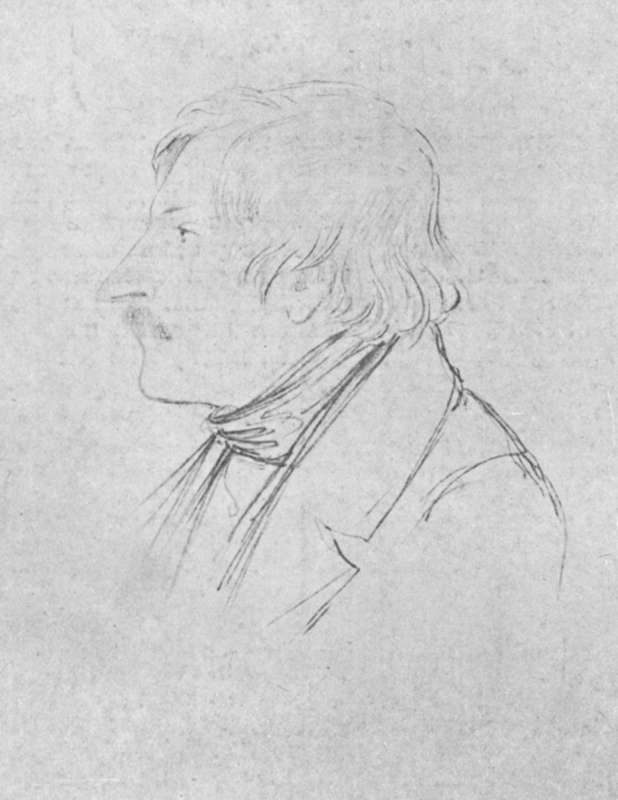
On the 25th March, 18—, a very strange occurrence took place in St Petersburg. On the Ascension Avenue there lived a barber of the name of Ivan Jakovlevitch. He had lost his family name, and on his sign-board, on which was depicted the head of a gentleman with one cheek soaped, the only inscription to be read was, “Blood-letting done here.”
On this particular morning he awoke pretty early. Becoming aware of the smell of fresh-baked bread, he sat up a little in bed, and saw his wife, who had a special partiality for coffee, in the act of taking some fresh-baked bread out of the oven.
“To-day, Prasskovna Ossipovna,” he said, “I do not want any coffee; I should like a fresh loaf with onions.”
“The blockhead may eat bread only as far as I am concerned,” said his wife to herself; “then I shall have a chance of getting some coffee.” And she threw a loaf on the table.
For the sake of propriety, Ivan Jakovlevitch drew a coat over his shirt, sat down at the table, shook out some salt for himself, prepared two onions, assumed a serious expression, and began to cut the bread. After he had cut the loaf in two halves, he looked, and to his great astonishment saw something whitish sticking in it. He carefully poked round it with his knife, and felt it with his finger.
“Quite firmly fixed!” he murmured in his beard. “What can it be?”
He put in his finger, and drew out—a nose!
Ivan Jakovlevitch at first let his hands fall from sheer astonishment; then he rubbed his eyes and began to feel it. A nose, an actual nose; and, moreover, it seemed to be the nose of an acquaintance! Alarm and terror were depicted in Ivan’s face; but these feelings were slight in comparison with the disgust which took possession of his wife.
“Whose nose have you cut off, you monster?” she screamed, her face red with anger. “You scoundrel! You tippler! I myself will report you to the police! Such a rascal! Many customers have told me that while you were shaving them, you held them so tight by the nose that they could hardly sit still.”
But Ivan Jakovlevitch was more dead than alive; he saw at once that this nose could belong to no other than to Kovaloff, a member of the Municipal Committee whom he shaved every Sunday and Wednesday.
“Stop, Prasskovna Ossipovna! I will wrap it in a piece of cloth and place it in the corner. There it may remain for the present; later on I will take it away.”
“No, not there! Shall I endure an amputated nose in my room? You understand nothing except how to strop a razor. You know nothing of the duties and obligations of a respectable man. You vagabond! You good-for-nothing! Am I to undertake all responsibility for you at the police-office? Ah, you soap-smearer! You blockhead! Take it away where you like, but don’t let it stay under my eyes!”
Ivan Jakovlevitch stood there flabbergasted. He thought and thought, and knew not what he thought.
“The devil knows how that happened!” he said at last, scratching his head behind his ear. “Whether I came home drunk last night or not, I really don’t know; but in all probability this is a quite extraordinary occurrence, for a loaf is something baked and a nose is something different. I don’t understand the matter at all.” And Ivan Jakovlevitch was silent. The thought that the police might find him in unlawful possession of a nose and arrest him, robbed him of all presence of mind. Already he began to have visions of a red collar with silver braid and of a sword—and he trembled all over.
At last he finished dressing himself, and to the accompaniment of the emphatic exhortations of his spouse, he wrapped up the nose in a cloth and issued into the street.
He intended to lose it somewhere—either at somebody’s door, or in a public square, or in a narrow alley; but just then, in order to complete his bad luck, he was met by an acquaintance, who showered inquiries upon him. “Hullo, Ivan Jakovlevitch! Whom are you going to shave so early in the morning?” etc., so that he could find no suitable opportunity to do what he wanted. Later on he did let the nose drop, but a sentry bore down upon him with his halberd, and said, “Look out! You have let something drop!” and Ivan Jakovlevitch was obliged to pick it up and put it in his pocket.
A feeling of despair began to take possession of him; all the more as the streets became more thronged and the merchants began to open their shops. At last he resolved to go to the Isaac Bridge, where perhaps he might succeed in throwing it into the Neva.
But my conscience is a little uneasy that I have not yet given any detailed information about Ivan Jakovlevitch, an estimable man in many ways.
Like every honest Russian tradesman, Ivan Jakovlevitch was a terrible drunkard, and although he shaved other people’s faces every day, his own was always unshaved. His coat (he never wore an overcoat) was quite mottled, i.e. it had been black, but become brownish-yellow; the collar was quite shiny, and instead of the three buttons, only the threads by which they had been fastened were to be seen.
Ivan Jakovlevitch was a great cynic, and when Kovaloff, the member of the Municipal Committee, said to him, as was his custom while being shaved, “Your hands always smell, Ivan Jakovlevitch!” the latter answered, “What do they smell of?” “I don’t know, my friend, but they smell very strong.” Ivan Jakovlevitch after taking a pinch of snuff would then, by way of reprisals, set to work to soap him on the cheek, the upper lip, behind the ears, on the chin, and everywhere.
This worthy man now stood on the Isaac Bridge. At first he looked round him, then he leant on the railings of the bridge, as though he wished to look down and see how many fish were swimming past, and secretly threw the nose, wrapped in a little piece of cloth, into the water. He felt as though a ton weight had been lifted off him, and laughed cheerfully. Instead, however, of going to shave any officials, he turned his steps to a building, the sign-board of which bore the legend “Teas served here,” in order to have a glass of punch, when suddenly he perceived at the other end of the bridge a police inspector of imposing exterior, with long whiskers, three-cornered hat, and sword hanging at his side. He nearly fainted; but the police inspector beckoned to him with his hand and said, “Come here, my dear sir.”
Ivan Jakovlevitch, knowing how a gentleman should behave, took his hat off quickly, went towards the police inspector and said, “I hope you are in the best of health.”
“Never mind my health. Tell me, my friend, why you were standing on the bridge.”
“By heaven, gracious sir, I was on the way to my customers, and only looked down to see if the river was flowing quickly.”
“That is a lie! You won’t get out of it like that. Confess the truth.”
“I am willing to shave Your Grace two or even three times a week gratis,” answered Ivan Jakovlevitch.
“No, my friend, don’t put yourself out! Three barbers are busy with me already, and reckon it a high honour that I let them show me their skill. Now then, out with it! What were you doing there?”
Ivan Jakovlevitch grew pale. But here the strange episode vanishes in mist, and what further happened is not known.
Kovaloff, the member of the Municipal Committee, awoke fairly early that morning, and made a droning noise—“Brr! Brr!”—through his lips, as he always did, though he could not say why. He stretched himself, and told his valet to give him a little mirror which was on the table. He wished to look at the heat-boil which had appeared on his nose the previous evening; but to his great astonishment, he saw that instead of his nose he had a perfectly smooth vacancy in his face. Thoroughly alarmed, he ordered some water to be brought, and rubbed his eyes with a towel. Sure enough, he had no longer a nose! Then he sprang out of bed, and shook himself violently! No, no nose any more! He dressed himself and went at once to the police superintendent.
But before proceeding further, we must certainly give the reader some information about Kovaloff, so that he may know what sort of a man this member of the Municipal Committee really was. These committee-men, who obtain that title by means of certificates of learning, must not be compared with the committee-men appointed for the Caucasus district, who are of quite a different kind. The learned committee-man—but Russia is such a wonderful country that when one committee-man is spoken of all the others from Riga to Kamschatka refer it to themselves. The same is also true of all other titled officials. Kovaloff had been a Caucasian committee-man two years previously, and could not forget that he had occupied that position; but in order to enhance his own importance, he never called himself “committee-man” but “Major.”
“Listen, my dear,” he used to say when he met an old woman in the street who sold shirt-fronts; “go to my house in Sadovaia Street and ask ‘Does Major Kovaloff live here?’ Any child can tell you where it is.”
Accordingly we will call him for the future Major Kovaloff. It was his custom to take a daily walk on the Neffsky Avenue. The collar of his shirt was always remarkably clean and stiff. He wore the same style of whiskers as those that are worn by governors of districts, architects, and regimental doctors; in short, all those who have full red cheeks and play a good game of whist. These whiskers grow straight across the cheek towards the nose.
Major Kovaloff wore a number of seals, on some of which were engraved armorial bearings, and others the names of the days of the week. He had come to St Petersburg with the view of obtaining some position corresponding to his rank, if possible that of vice-governor of a province; but he was prepared to be content with that of a bailiff in some department or other. He was, moreover, not disinclined to marry, but only such a lady who could bring with her a dowry of two hundred thousand roubles. Accordingly, the reader can judge for himself what his sensations were when he found in his face, instead of a fairly symmetrical nose, a broad, flat vacancy.
To increase his misfortune, not a single droshky was to be seen in the street, and so he was obliged to proceed on foot. He wrapped himself up in his cloak, and held his handkerchief to his face as though his nose bled. “But perhaps it is all only my imagination; it is impossible that a nose should drop off in such a silly way,” he thought, and stepped into a confectioner’s shop in order to look into the mirror.
Fortunately no customer was in the shop; only small shop-boys were cleaning it out, and putting chairs and tables straight. Others with sleepy faces were carrying fresh cakes on trays, and yesterday’s newspapers stained with coffee were still lying about. “Thank God no one is here!” he said to himself. “Now I can look at myself leisurely.”
He stepped gingerly up to a mirror and looked.
“What an infernal face!” he exclaimed, and spat with disgust. “If there were only something there instead of the nose, but there is absolutely nothing.”
He bit his lips with vexation, left the confectioner’s, and resolved, quite contrary to his habit, neither to look nor smile at anyone on the street. Suddenly he halted as if rooted to the spot before a door, where something extraordinary happened. A carriage drew up at the entrance; the carriage door was opened, and a gentleman in uniform came out and hurried up the steps. How great was Kovaloff’s terror and astonishment when he saw that it was his own nose!
At this extraordinary sight, everything seemed to turn round with him. He felt as though he could hardly keep upright on his legs; but, though trembling all over as though with fever, he resolved to wait till the nose should return to the carriage. After about two minutes the nose actually came out again. It wore a gold-embroidered uniform with a stiff, high collar, trousers of chamois leather, and a sword hung at its side. The hat, adorned with a plume, showed that it held the rank of a state-councillor. It was obvious that it was paying “duty-calls.” It looked round on both sides, called to the coachman “Drive on,” and got into the carriage, which drove away.
Poor Kovaloff nearly lost his reason. He did not know what to think of this extraordinary procedure. And indeed how was it possible that the nose, which only yesterday he had on his face, and which could neither walk nor drive, should wear a uniform. He ran after the carriage, which fortunately had stopped a short way off before the Grand Bazar of Moscow. He hurried towards it and pressed through a crowd of beggar-women with their faces bound up, leaving only two openings for the eyes, over whom he had formerly so often made merry.
There were only a few people in front of the Bazar. Kovaloff was so agitated that he could decide on nothing, and looked for the nose everywhere. At last he saw it standing before a shop. It seemed half buried in its stiff collar, and was attentively inspecting the wares displayed.
“How can I get at it?” thought Kovaloff. “Everything—the uniform, the hat, and so on—show that it is a state-councillor. How the deuce has that happened?”
He began to cough discreetly near it, but the nose paid him not the least attention.
“Honourable sir,” said Kovaloff at last, plucking up courage, “honourable sir.”
“What do you want?” asked the nose, and turned round.
“It seems to me strange, most respected sir—you should know where you belong—and I find you all of a sudden—where? Judge yourself.”
“Pardon me, I do not understand what you are talking about. Explain yourself more distinctly.”
“How shall I make my meaning plainer to him?” Then plucking up fresh courage, he continued, “Naturally—besides I am a Major. You must admit it is not befitting that I should go about without a nose. An old apple-woman on the Ascension Bridge may carry on her business without one, but since I am on the look out for a post; besides in many houses I am acquainted with ladies of high position—Madame Tchektyriev, wife of a state-councillor, and many others. So you see—I do not know, honourable sir, what you----” (here the Major shrugged his shoulders). “Pardon me; if one regards the matter from the point of view of duty and honour—you will yourself understand----”
“I understand nothing,” answered the nose. “I repeat, please explain yourself more distinctly.”
“Honourable sir,” said Kovaloff with dignity, “I do not know how I am to understand your words. It seems to me the matter is as clear as possible. Or do you wish—but you are after all my own nose!”
The nose looked at the Major and wrinkled its forehead. “There you are wrong, respected sir; I am myself. Besides, there can be no close relations between us. To judge by the buttons of your uniform, you must be in quite a different department to mine.” So saying, the nose turned away.
Kovaloff was completely puzzled; he did not know what to do, and still less what to think. At this moment he heard the pleasant rustling of a lady’s dress, and there approached an elderly lady wearing a quantity of lace, and by her side her graceful daughter in a white dress which set off her slender figure to advantage, and wearing a light straw hat. Behind the ladies marched a tall lackey with long whiskers.
Kovaloff advanced a few steps, adjusted his cambric collar, arranged his seals which hung by a little gold chain, and with smiling face fixed his eyes on the graceful lady, who bowed lightly like a spring flower, and raised to her brow her little white hand with transparent fingers. He smiled still more when he spied under the brim of her hat her little round chin, and part of her cheek faintly tinted with rose-colour. But suddenly he sprang back as though he had been scorched. He remembered that he had nothing but an absolute blank in place of a nose, and tears started to his eyes. He turned round in order to tell the gentleman in uniform that he was only a state-councillor in appearance, but really a scoundrel and a rascal, and nothing else but his own nose; but the nose was no longer there. He had had time to go, doubtless in order to continue his visits.
His disappearance plunged Kovaloff into despair. He went back and stood for a moment under a colonnade, looking round him on all sides in hope of perceiving the nose somewhere. He remembered very well that it wore a hat with a plume in it and a gold-embroidered uniform; but he had not noticed the shape of the cloak, nor the colour of the carriages and the horses, nor even whether a lackey stood behind it, and, if so, what sort of livery he wore. Moreover, so many carriages were passing that it would have been difficult to recognise one, and even if he had done so, there would have been no means of stopping it.
The day was fine and sunny. An immense crowd was passing to and fro in the Neffsky Avenue; a variegated stream of ladies flowed along the pavement. There was his acquaintance, the Privy Councillor, whom he was accustomed to style “General,” especially when strangers were present. There was Iarygin, his intimate friend who always lost in the evenings at whist; and there another Major, who had obtained the rank of committee-man in the Caucasus, beckoned to him.
“Go to the deuce!” said Kovaloff sotto voce. “Hi! coachman, drive me straight to the superintendent of police.” So saying, he got into a droshky and continued to shout all the time to the coachman “Drive hard!”
“Is the police superintendent at home?” he asked on entering the front hall.
“No, sir,” answered the porter, “he has just gone out.”
“Ah, just as I thought!”
“Yes,” continued the porter, “he has only just gone out; if you had been a moment earlier you would perhaps have caught him.”
Kovaloff, still holding his handkerchief to his face, re-entered the droshky and cried in a despairing voice “Drive on!”
“Where?” asked the coachman.
“Straight on!”
“But how? There are cross-roads here. Shall I go to the right or the left?”
This question made Kovaloff reflect. In his situation it was necessary to have recourse to the police; not because the affair had anything to do with them directly but because they acted more promptly than other authorities. As for demanding any explanation from the department to which the nose claimed to belong, it would, he felt, be useless, for the answers of that gentleman showed that he regarded nothing as sacred, and he might just as likely have lied in this matter as in saying that he had never seen Kovaloff.
But just as he was about to order the coachman to drive to the police-station, the idea occurred to him that this rascally scoundrel who, at their first meeting, had behaved so disloyally towards him, might, profiting by the delay, quit the city secretly; and then all his searching would be in vain, or might last over a whole month. Finally, as though visited with a heavenly inspiration, he resolved to go directly to an advertisement office, and to advertise the loss of his nose, giving all its distinctive characteristics in detail, so that anyone who found it might bring it at once to him, or at any rate inform him where it lived. Having decided on this course, he ordered the coachman to drive to the advertisement office, and all the way he continued to punch him in the back—“Quick, scoundrel! quick!”
“Yes, sir!” answered the coachman, lashing his shaggy horse with the reins.
At last they arrived, and Kovaloff, out of breath, rushed into a little room where a grey-haired official, in an old coat and with spectacles on his nose, sat at a table holding his pen between his teeth, counting a heap of copper coins.
“Who takes in the advertisements here?” exclaimed Kovaloff.
“At your service, sir,” answered the grey-haired functionary, looking up and then fastening his eyes again on the heap of coins before him.
“I wish to place an advertisement in your paper----”
“Have the kindness to wait a minute,” answered the official, putting down figures on paper with one hand, and with the other moving two balls on his calculating-frame.
A lackey, whose silver-laced coat showed that he served in one of the houses of the nobility, was standing by the table with a note in his hand, and speaking in a lively tone, by way of showing himself sociable. “Would you believe it, sir, this little dog is really not worth twenty-four kopecks, and for my own part I would not give a farthing for it; but the countess is quite gone upon it, and offers a hundred roubles’ reward to anyone who finds it. To tell you the truth, the tastes of these people are very different from ours; they don’t mind giving five hundred or a thousand roubles for a poodle or a pointer, provided it be a good one.”
The official listened with a serious air while counting the number of letters contained in the note. At either side of the table stood a number of housekeepers, clerks and porters, carrying notes. The writer of one wished to sell a barouche, which had been brought from Paris in 1814 and had been very little used; others wanted to dispose of a strong droshky which wanted one spring, a spirited horse seventeen years old, and so on. The room where these people were collected was very small, and the air was very close; but Kovaloff was not affected by it, for he had covered his face with a handkerchief, and because his nose itself was heaven knew where.
“Sir, allow me to ask you—I am in a great hurry,” he said at last impatiently.
“In a moment! In a moment! Two roubles, twenty-four kopecks—one minute! One rouble, sixty-four kopecks!” said the grey-haired official, throwing their notes back to the housekeepers and porters. “What do you wish?” he said, turning to Kovaloff.
“I wish—” answered the latter, “I have just been swindled and cheated, and I cannot get hold of the perpetrator. I only want you to insert an advertisement to say that whoever brings this scoundrel to me will be well rewarded.”
“What is your name, please?”
“Why do you want my name? I have many lady friends—Madame Tchektyriev, wife of a state-councillor, Madame Podtotchina, wife of a Colonel. Heaven forbid that they should get to hear of it. You can simply write ‘committee-man,’ or, better, ‘Major.’”
“And the man who has run away is your serf.”
“Serf! If he was, it would not be such a great swindle! It is the nose which has absconded.”
“H’m! What a strange name. And this Mr Nose has stolen from you a considerable sum?”
“Mr Nose! Ah, you don’t understand me! It is my own nose which has gone, I don’t know where. The devil has played a trick on me.”
“How has it disappeared? I don’t understand.”
“I can’t tell you how, but the important point is that now it walks about the city itself a state-councillor. That is why I want you to advertise that whoever gets hold of it should bring it as soon as possible to me. Consider; how can I live without such a prominent part of my body? It is not as if it were merely a little toe; I would only have to put my foot in my boot and no one would notice its absence. Every Thursday I call on the wife of M. Tchektyriev, the state-councillor; Madame Podtotchina, a Colonel’s wife who has a very pretty daughter, is one of my acquaintances; and what am I to do now? I cannot appear before them like this.”
The official compressed his lips and reflected. “No, I cannot insert an advertisement like that,” he said after a long pause.
“What! Why not?”
“Because it might compromise the paper. Suppose everyone could advertise that his nose was lost. People already say that all sorts of nonsense and lies are inserted.”
“But this is not nonsense! There is nothing of that sort in my case.”
“You think so? Listen a minute. Last week there was a case very like it. An official came, just as you have done, bringing an advertisement for the insertion of which he paid two roubles, sixty-three kopecks; and this advertisement simply announced the loss of a black-haired poodle. There did not seem to be anything out of the way in it, but it was really a satire; by the poodle was meant the cashier of some establishment or other.”
“But I am not talking of a poodle, but my own nose; i.e. almost myself.”
“No, I cannot insert your advertisement.”
“But my nose really has disappeared!”
“That is a matter for a doctor. There are said to be people who can provide you with any kind of nose you like. But I see that you are a witty man, and like to have your little joke.”
“But I swear to you on my word of honour. Look at my face yourself.”
“Why put yourself out?” continued the official, taking a pinch of snuff. “All the same, if you don’t mind,” he added with a touch of curiosity, “I should like to have a look at it.”
The committee-man removed the handkerchief from before his face.
“It certainly does look odd,” said the official. “It is perfectly flat like a freshly fried pancake. It is hardly credible.”
“Very well. Are you going to hesitate any more? You see it is impossible to refuse to advertise my loss. I shall be particularly obliged to you, and I shall be glad that this incident has procured me the pleasure of making your acquaintance.” The Major, we see, did not even shrink from a slight humiliation.
“It certainly is not difficult to advertise it,” replied the official; “but I don’t see what good it would do you. However, if you lay so much stress on it, you should apply to someone who has a skilful pen, so that he may describe it as a curious, natural freak, and publish the article in the Northern Bee” (here he took another pinch) “for the benefit of youthful readers” (he wiped his nose), “or simply as a matter worthy of arousing public curiosity.”
The committee-man felt completely discouraged. He let his eyes fall absent-mindedly on a daily paper in which theatrical performances were advertised. Reading there the name of an actress whom he knew to be pretty, he involuntarily smiled, and his hand sought his pocket to see if he had a blue ticket—for in Kovaloff’s opinion superior officers like himself should not take a lesser-priced seat; but the thought of his lost nose suddenly spoilt everything.
The official himself seemed touched at his difficult position. Desiring to console him, he tried to express his sympathy by a few polite words. “I much regret,” he said, “your extraordinary mishap. Will you not try a pinch of snuff? It clears the head, banishes depression, and is a good preventive against haemorrhoids.”
So saying, he reached his snuff-box out to Kovaloff, skilfully concealing at the same time the cover, which was adorned with the portrait of some lady or other.
This act, quite innocent in itself, exasperated Kovaloff. “I don’t understand what you find to joke about in the matter,” he exclaimed angrily. “Don’t you see that I lack precisely the essential feature for taking snuff? The devil take your snuff-box. I don’t want to look at snuff now, not even the best, certainly not your vile stuff!”
So saying, he left the advertisement office in a state of profound irritation, and went to the commissary of police. He arrived just as this dignitary was reclining on his couch, and saying to himself with a sigh of satisfaction, “Yes, I shall make a nice little sum out of that.”
It might be expected, therefore, that the committee-man’s visit would be quite inopportune.
This police commissary was a great patron of all the arts and industries; but what he liked above everything else was a cheque. “It is a thing,” he used to say, “to which it is not easy to find an equivalent; it requires no food, it does not take up much room, it stays in one’s pocket, and if it falls, it is not broken.”
The commissary accorded Kovaloff a fairly frigid reception, saying that the afternoon was not the best time to come with a case, that nature required one to rest a little after eating (this showed the committee-man that the commissary was acquainted with the aphorisms of the ancient sages), and that respectable people did not have their noses stolen.
The last allusion was too direct. We must remember that Kovaloff was a very sensitive man. He did not mind anything said against him as an individual, but he could not endure any reflection on his rank or social position. He even believed that in comedies one might allow attacks on junior officers, but never on their seniors.
The commissary’s reception of him hurt his feelings so much that he raised his head proudly, and said with dignity, “After such insulting expressions on your part, I have nothing more to say.” And he left the place.
He reached his house quite wearied out. It was already growing dark. After all his fruitless search, his room seemed to him melancholy and even ugly. In the vestibule he saw his valet Ivan stretched on the leather couch and amusing himself by spitting at the ceiling, which he did very cleverly, hitting every time the same spot. His servant’s equanimity enraged him; he struck him on the forehead with his hat, and said, “You good-for-nothing, you are always playing the fool!”
Ivan rose quickly and hastened to take off his master’s cloak.
Once in his room, the Major, tired and depressed, threw himself in an armchair and, after sighing a while, began to soliloquise:
“In heaven’s name, why should such a misfortune befall me? If I had lost an arm or a leg, it would be less insupportable; but a man without a nose! Devil take it!—what is he good for? He is only fit to be thrown out of the window. If it had been taken from me in war or in a duel, or if I had lost it by my own fault! But it has disappeared inexplicably. But no! it is impossible,” he continued after reflecting a few moments, “it is incredible that a nose can disappear like that—quite incredible. I must be dreaming, or suffering from some hallucination; perhaps I swallowed, by mistake instead of water, the brandy with which I rub my chin after being shaved. That fool of an Ivan must have forgotten to take it away, and I must have swallowed it.”
In order to find out whether he were really drunk, the Major pinched himself so hard that he unvoluntarily uttered a cry. The pain convinced him that he was quite wide awake. He walked slowly to the looking-glass and at first closed his eyes, hoping to see his nose suddenly in its proper place; but on opening them, he started back. “What a hideous sight!” he exclaimed.
It was really incomprehensible. One might easily lose a button, a silver spoon, a watch, or something similar; but a loss like this, and in one’s own dwelling!
After considering all the circumstances, Major Kovaloff felt inclined to suppose that the cause of all his trouble should be laid at the door of Madame Podtotchina, the Colonel’s wife, who wished him to marry her daughter. He himself paid her court readily, but always avoided coming to the point. And when the lady one day told him point-blank that she wished him to marry her daughter, he gently drew back, declaring that he was still too young, and that he had to serve five years more before he would be forty-two. This must be the reason why the lady, in revenge, had resolved to bring him into disgrace, and had hired two sorceresses for that object. One thing was certain—his nose had not been cut off; no one had entered his room, and as for Ivan Jakovlevitch—he had been shaved by him on Wednesday, and during that day and the whole of Thursday his nose had been there, as he knew and well remembered. Moreover, if his nose had been cut off he would naturally have felt pain, and doubtless the wound would not have healed so quickly, nor would the surface have been as flat as a pancake.
All kinds of plans passed through his head: should he bring a legal action against the wife of a superior officer, or should he go to her and charge her openly with her treachery?
His reflections were interrupted by a sudden light, which shone through all the chinks of the door, showing that Ivan had lit the wax-candles in the vestibule. Soon Ivan himself came in with the lights. Kovaloff quickly seized a handkerchief and covered the place where his nose had been the evening before, so that his blockhead of a servant might not gape with his mouth wide open when he saw his master’s extraordinary appearance.
Scarcely had Ivan returned to the vestibule than a stranger’s voice was heard there.
“Does Major Kovaloff live here?” it asked.
“Come in!” said the Major, rising rapidly and opening the door.
He saw a police official of pleasant appearance, with grey whiskers and fairly full cheeks—the same who at the commencement of this story was standing at the end of the Isaac Bridge. “You have lost your nose?” he asked.
“Exactly so.”
“It has just been found.”
“What—do you say?” stammered Major Kovaloff.
Joy had suddenly paralysed his tongue. He stared at the police commissary on whose cheeks and full lips fell the flickering light of the candle.
“How was it?” he asked at last.
“By a very singular chance. It has been arrested just as it was getting into a carriage for Riga. Its passport had been made out some time ago in the name of an official; and what is still more strange, I myself took it at first for a gentleman. Fortunately I had my glasses with me, and then I saw at once that it was a nose. I am shortsighted, you know, and as you stand before me I cannot distinguish your nose, your beard, or anything else. My mother-in-law can hardly see at all.”
Kovaloff was beside himself with excitement. “Where is it? Where? I will hasten there at once.”
“Don’t put yourself out. Knowing that you need it, I have brought it with me. Another singular thing is that the principal culprit in the matter is a scoundrel of a barber living in the Ascension Avenue, who is now safely locked up. I had long suspected him of drunkenness and theft; only the day before yesterday he stole some buttons in a shop. Your nose is quite uninjured.” So saying, the police commissary put his hand in his pocket and brought out the nose wrapped up in paper.
“Yes, yes, that is it!” exclaimed Kovaloff. “Will you not stay and drink a cup of tea with me?”
“I should like to very much, but I cannot. I must go at once to the House of Correction. The cost of living is very high nowadays. My mother-in-law lives with me, and there are several children; the eldest is very hopeful and intelligent, but I have no means for their education.”
After the commissary’s departure, Kovaloff remained for some time plunged in a kind of vague reverie, and did not recover full consciousness for several moments, so great was the effect of this unexpected good news. He placed the recovered nose carefully in the palm of his hand, and examined it again with the greatest attention.
“Yes, this is it!” he said to himself. “Here is the heat-boil on the left side, which came out yesterday.” And he nearly laughed aloud with delight.
But nothing is permanent in this world. Joy in the second moment of its arrival is already less keen than in the first, is still fainter in the third, and finishes by coalescing with our normal mental state, just as the circles which the fall of a pebble forms on the surface of water, gradually die away. Kovaloff began to meditate, and saw that his difficulties were not yet over; his nose had been recovered, but it had to be joined on again in its proper place.
And suppose it could not? As he put this question to himself, Kovaloff grew pale. With a feeling of indescribable dread, he rushed towards his dressing-table, and stood before the mirror in order that he might not place his nose crookedly. His hands trembled.
Very carefully he placed it where it had been before. Horror! It did not remain there. He held it to his mouth and warmed it a little with his breath, and then placed it there again; but it would not hold.
“Hold on, you stupid!” he said.
But the nose seemed to be made of wood, and fell back on the table with a strange noise, as though it had been a cork. The Major’s face began to twitch feverishly. “Is it possible that it won’t stick?” he asked himself, full of alarm. But however often he tried, all his efforts were in vain.
He called Ivan, and sent him to fetch the doctor who occupied the finest flat in the mansion. This doctor was a man of imposing appearance, who had magnificent black whiskers and a healthy wife. He ate fresh apples every morning, and cleaned his teeth with extreme care, using five different tooth-brushes for three-quarters of an hour daily.
The doctor came immediately. After having asked the Major when this misfortune had happened, he raised his chin and gave him a fillip with his finger just where the nose had been, in such a way that the Major suddenly threw back his head and struck the wall with it. The doctor said that did not matter; then, making him turn his face to the right, he felt the vacant place and said “H’m!” then he made him turn it to the left and did the same; finally he again gave him a fillip with his finger, so that the Major started like a horse whose teeth are being examined. After this experiment, the doctor shook his head and said, “No, it cannot be done. Rather remain as you are, lest something worse happen. Certainly one could replace it at once, but I assure you the remedy would be worse than the disease.”
“All very fine, but how am I to go on without a nose?” answered Kovaloff. “There is nothing worse than that. How can I show myself with such a villainous appearance? I go into good society, and this evening I am invited to two parties. I know several ladies, Madame Tchektyriev, the wife of a state-councillor, Madame Podtotchina—although after what she has done, I don’t want to have anything to do with her except through the agency of the police. I beg you,” continued Kovaloff in a supplicating tone, “find some way or other of replacing it; even if it is not quite firm, as long as it holds at all; I can keep it in place sometimes with my hand, whenever there is any risk. Besides, I do not even dance, so that it is not likely to be injured by any sudden movement. As to your fee, be in no anxiety about that; I can well afford it.”
“Believe me,” answered the doctor in a voice which was neither too high nor too low, but soft and almost magnetic, “I do not treat patients from love of gain. That would be contrary to my principles and to my art. It is true that I accept fees, but that is only not to hurt my patients’ feelings by refusing them. I could certainly replace your nose, but I assure you on my word of honour, it would only make matters worse. Rather let Nature do her own work. Wash the place often with cold water, and I assure you that even without a nose, you will be just as well as if you had one. As to the nose itself, I advise you to have it preserved in a bottle of spirits, or, still better, of warm vinegar mixed with two spoonfuls of brandy, and then you can sell it at a good price. I would be willing to take it myself, provided you do not ask too much.”
“No, no, I shall not sell it at any price. I would rather it were lost again.”
“Excuse me,” said the doctor, taking his leave. “I hoped to be useful to you, but I can do nothing more; you are at any rate convinced of my good-will.” So saying, the doctor left the room with a dignified air.
Kovaloff did not even notice his departure. Absorbed in a profound reverie, he only saw the edge of his snow-white cuffs emerging from the sleeves of his black coat.
The next day he resolved, before bringing a formal action, to write to the Colonel’s wife and see whether she would not return to him, without further dispute, that of which she had deprived him.
The letter ran as follows:
“To Madame Alexandra Podtotchina,
“I hardly understand your method of action. Be sure that by adopting such a course you will gain nothing, and will certainly not succeed in making me marry your daughter. Believe me, the story of my nose has become well known; it is you and no one else who have taken the principal part in it. Its unexpected separation from the place which it occupied, its flight and its appearances sometimes in the disguise of an official, sometimes in proper person, are nothing but the consequence of unholy spells employed by you or by persons who, like you, are addicted to such honourable pursuits. On my part, I wish to inform you, that if the above-mentioned nose is not restored to-day to its proper place, I shall be obliged to have recourse to legal procedure.
“For the rest, with all respect, I have the honour to be your humble servant,
“Platon Kovaloff.”
The reply was not long in coming, and was as follows:
“Major Platon Kovaloff,—
“Your letter has profoundly astonished me. I must confess that I had not expected such unjust reproaches on your part. I assure you that the official of whom you speak has not been at my house, either disguised or in his proper person. It is true that Philippe Ivanovitch Potantchikoff has paid visits at my house, and though he has actually asked for my daughter’s hand, and was a man of good breeding, respectable and intelligent, I never gave him any hope.
“Again, you say something about a nose. If you intend to imply by that that I wished to snub you, i.e. to meet you with a refusal, I am very astonished because, as you well know, I was quite of the opposite mind. If after this you wish to ask for my daughter’s hand, I should be glad to gratify you, for such has also been the object of my most fervent desire, in the hope of the accomplishment of which, I remain, yours most sincerely,
“Alexandra Podtotchina.”
“No,” said Kovaloff, after having reperused the letter, “she is certainly not guilty. It is impossible. Such a letter could not be written by a criminal.” The committee-man was experienced in such matters, for he had been often officially deputed to conduct criminal investigations while in the Caucasus. “But then how and by what trick of fate has the thing happened?” he said to himself with a gesture of discouragement. “The devil must be at the bottom of it.”
Meanwhile the rumour of this extraordinary event had spread all over the city, and, as is generally the case, not without numerous additions. At that period there was a general disposition to believe in the miraculous; the public had recently been impressed by experiments in magnetism. The story of the floating chairs in Koniouchennaia Street was still quite recent, and there was nothing astonishing in hearing soon afterwards that Major Kovaloff’s nose was to be seen walking every day at three o’clock on the Neffsky Avenue. The crowd of curious spectators which gathered there daily was enormous. On one occasion someone spread a report that the nose was in Junker’s stores and immediately the place was besieged by such a crowd that the police had to interfere and establish order. A certain speculator with a grave, whiskered face, who sold cakes at a theatre door, had some strong wooden benches made which he placed before the window of the stores, and obligingly invited the public to stand on them and look in, at the modest charge of twenty-four kopecks. A veteran colonel, leaving his house earlier than usual expressly for the purpose, had the greatest difficulty in elbowing his way through the crowd, but to his great indignation he saw nothing in the store window but an ordinary flannel waistcoat and a coloured lithograph representing a young girl darning a stocking, while an elegant youth in a waistcoat with large lappels watched her from behind a tree. The picture had hung in the same place for more than ten years. The colonel went off, growling savagely to himself, “How can the fools let themselves be excited by such idiotic stories?”
Then another rumour got abroad, to the effect that the nose of Major Kovaloff was in the habit of walking not on the Neffsky Avenue but in the Tauris Gardens. Some students of the Academy of Surgery went there on purpose to see it. A high-born lady wrote to the keeper of the gardens asking him to show her children this rare phenomenon, and to give them some suitable instruction on the occasion.
All these incidents were eagerly collected by the town wits, who just then were very short of anecdotes adapted to amuse ladies. On the other hand, the minority of solid, sober people were very much displeased. One gentleman asserted with great indignation that he could not understand how in our enlightened age such absurdities could spread abroad, and he was astonished that the Government did not direct their attention to the matter. This gentleman evidently belonged to the category of those people who wish the Government to interfere in everything, even in their daily quarrels with their wives.
But here the course of events is again obscured by a veil.
Strange events happen in this world, events which are sometimes entirely improbable. The same nose which had masqueraded as a state-councillor, and caused so much sensation in the town, was found one morning in its proper place, i.e. between the cheeks of Major Kovaloff, as if nothing had happened.
This occurred on 7th April. On awaking, the Major looked by chance into a mirror and perceived a nose. He quickly put his hand to it; it was there beyond a doubt!
“Oh!” exclaimed Kovaloff. For sheer joy he was on the point of performing a dance barefooted across his room, but the entrance of Ivan prevented him. He told him to bring water, and after washing himself, he looked again in the glass. The nose was there! Then he dried his face with a towel and looked again. Yes, there was no mistake about it!
“Look here, Ivan, it seems to me that I have a heat-boil on my nose,” he said to his valet.
And he thought to himself at the same time, “That will be a nice business if Ivan says to me ‘No, sir, not only is there no boil, but your nose itself is not there!’”
But Ivan answered, “There is nothing, sir; I can see no boil on your nose.”
“Good! Good!” exclaimed the Major, and snapped his fingers with delight.
At this moment the barber, Ivan Jakovlevitch, put his head in at the door, but as timidly as a cat which has just been beaten for stealing lard.
“Tell me first, are your hands clean?” asked Kovaloff when he saw him.
“Yes, sir.”
“You lie.”
“I swear they are perfectly clean, sir.”
“Very well; then come here.”
Kovaloff seated himself. Jakovlevitch tied a napkin under his chin, and in the twinkling of an eye covered his beard and part of his cheeks with a copious creamy lather.
“There it is!” said the barber to himself, as he glanced at the nose. Then he bent his head a little and examined it from one side. “Yes, it actually is the nose—really, when one thinks----” he continued, pursuing his mental soliloquy and still looking at it. Then quite gently, with infinite precaution, he raised two fingers in the air in order to take hold of it by the extremity, as he was accustomed to do.
“Now then, take care!” Kovaloff exclaimed.
Ivan Jakovlevitch let his arm fall and felt more embarrassed than he had ever done in his life. At last he began to pass the razor very lightly over the Major’s chin, and although it was very difficult to shave him without using the olfactory organ as a point of support, he succeeded, however, by placing his wrinkled thumb against the Major’s lower jaw and cheek, thus overcoming all obstacles and bringing his task to a safe conclusion.
When the barber had finished, Kovaloff hastened to dress himself, took a droshky, and drove straight to the confectioner’s. As he entered it, he ordered a cup of chocolate. He then stepped straight to the mirror; the nose was there!
He returned joyfully, and regarded with a satirical expression two officers who were in the shop, one of whom possessed a nose not much larger than a waistcoat button.
After that he went to the office of the department where he had applied for the post of vice-governor of a province or Government bailiff. As he passed through the hall of reception, he cast a glance at the mirror; the nose was there! Then he went to pay a visit to another committee-man, a very sarcastic personage, to whom he was accustomed to say in answer to his raillery, “Yes, I know, you are the funniest fellow in St Petersburg.”
On the way he said to himself, “If the Major does not burst into laughter at the sight of me, that is a most certain sign that everything is in its accustomed place.”
But the Major said nothing. “Very good!” thought Kovaloff.
As he returned, he met Madame Podtotchina with her daughter. He accosted them, and they responded very graciously. The conversation lasted a long time, during which he took more than one pinch of snuff, saying to himself, “No, you haven’t caught me yet, coquettes that you are! And as to the daughter, I shan’t marry her at all.”
After that, the Major resumed his walks on the Neffsky Avenue and his visits to the theatre as if nothing had happened. His nose also remained in its place as if it had never quitted it. From that time he was always to be seen smiling, in a good humour, and paying attentions to pretty girls.
Such was the occurrence which took place in the northern capital of our vast empire. On considering the account carefully we see that there is a good deal which looks improbable about it. Not to speak of the strange disappearance of the nose, and its appearance in different places under the disguise of a councillor of state, how was it that Kovaloff did not understand that one cannot decently advertise for a lost nose? I do not mean to say that he would have had to pay too much for the advertisement—that is a mere trifle, and I am not one of those who attach too much importance to money; but to advertise in such a case is not proper nor befitting.
Another difficulty is—how was the nose found in the baked loaf, and how did Ivan Jakovlevitch himself—no, I don’t understand it at all!
But the most incomprehensible thing of all is, how authors can choose such subjects for their stories. That really surpasses my understanding. In the first place, no advantage results from it for the country; and in the second place, no harm results either.
All the same, when one reflects well, there really is something in the matter. Whatever may be said to the contrary, such cases do occur—rarely, it is true, but now and then actually.
MEMOIRS OF A MADMAN
October 3rd.—A strange occurrence has taken place to-day. I got up fairly late, and when Mawra brought me my clean boots, I asked her how late it was. When I heard it had long struck ten, I dressed as quickly as possible.
To tell the truth, I would rather not have gone to the office at all to-day, for I know beforehand that our department-chief will look as sour as vinegar. For some time past he has been in the habit of saying to me, “Look here, my friend; there is something wrong with your head. You often rush about as though you were possessed. Then you make such confused abstracts of the documents that the devil himself cannot make them out; you write the title without any capital letters, and add neither the date nor the docket-number.” The long-legged scoundrel! He is certainly envious of me, because I sit in the director’s work-room, and mend His Excellency’s pens. In a word, I should not have gone to the office if I had not hoped to meet the accountant, and perhaps squeeze a little advance out of this skinflint.
A terrible man, this accountant! As for his advancing one’s salary once in a way—you might sooner expect the skies to fall. You may beg and beseech him, and be on the very verge of ruin—this grey devil won’t budge an inch. At the same time, his own cook at home, as all the world knows, boxes his ears.
I really don’t see what good one gets by serving in our department. There are no plums there. In the fiscal and judicial offices it is quite different. There some ungainly fellow sits in a corner and writes and writes; he has such a shabby coat and such an ugly mug that one would like to spit on both of them. But you should see what a splendid country-house he has rented. He would not condescend to accept a gilt porcelain cup as a present. “You can give that to your family doctor,” he would say. Nothing less than a pair of chestnut horses, a fine carriage, or a beaver-fur coat worth three hundred roubles would be good enough for him. And yet he seems so mild and quiet, and asks so amiably, “Please lend me your penknife; I wish to mend my pen.” Nevertheless, he knows how to scarify a petitioner till he has hardly a whole stitch left on his body.
In our office it must be admitted everything is done in a proper and gentlemanly way; there is more cleanness and elegance than one will ever find in Government offices. The tables are mahogany, and everyone is addressed as “sir.” And truly, were it not for this official propriety, I should long ago have sent in my resignation.
I put on my old cloak, and took my umbrella, as a light rain was falling. No one was to be seen on the streets except some women, who had flung their skirts over their heads. Here and there one saw a cabman or a shopman with his umbrella up. Of the higher classes one only saw an official here and there. One I saw at the street-crossing, and thought to myself, “Ah! my friend, you are not going to the office, but after that young lady who walks in front of you. You are just like the officers who run after every petticoat they see.”
As I was thus following the train of my thoughts, I saw a carriage stop before a shop just as I was passing it. I recognised it at once; it was our director’s carriage. “He has nothing to do in the shop,” I said to myself; “it must be his daughter.”
I pressed myself close against the wall. A lackey opened the carriage door, and, as I had expected, she fluttered like a bird out of it. How proudly she looked right and left; how she drew her eyebrows together, and shot lightnings from her eyes—good heavens! I am lost, hopelessly lost!
But why must she come out in such abominable weather? And yet they say women are so mad on their finery!
She did not recognise me. I had wrapped myself as closely as possible in my cloak. It was dirty and old-fashioned, and I would not have liked to have been seen by her wearing it. Now they wear cloaks with long collars, but mine has only a short double collar, and the cloth is of inferior quality.
Her little dog could not get into the shop, and remained outside. I know this dog; its name is “Meggy.”
Before I had been standing there a minute, I heard a voice call, “Good day, Meggy!”
Who the deuce was that? I looked round and saw two ladies hurrying by under an umbrella—one old, the other fairly young. They had already passed me when I heard the same voice say again, “For shame, Meggy!”
What was that? I saw Meggy sniffing at a dog which ran behind the ladies. The deuce! I thought to myself, “I am not drunk? That happens pretty seldom.”
“No, Fidel, you are wrong,” I heard Meggy say quite distinctly. “I was—bow—wow!—I was—bow! wow! wow!—very ill.”
What an extraordinary dog! I was, to tell the truth, quite amazed to hear it talk human language. But when I considered the matter well, I ceased to be astonished. In fact, such things have already happened in the world. It is said that in England a fish put its head out of water and said a word or two in such an extraordinary language that learned men have been puzzling over them for three years, and have not succeeded in interpreting them yet. I also read in the paper of two cows who entered a shop and asked for a pound of tea.
Meanwhile what Meggy went on to say seemed to me still more remarkable. She added, “I wrote to you lately, Fidel; perhaps Polkan did not bring you the letter.”
Now I am willing to forfeit a whole month’s salary if I ever heard of dogs writing before. This has certainly astonished me. For some little time past I hear and see things which no other man has heard and seen.
“I will,” I thought, “follow that dog in order to get to the bottom of the matter. Accordingly, I opened my umbrella and went after the two ladies. They went down Bean Street, turned through Citizen Street and Carpenter Street, and finally halted on the Cuckoo Bridge before a large house. I know this house; it is Sverkoff’s. What a monster he is! What sort of people live there! How many cooks, how many bagmen! There are brother officials of mine also there packed on each other like herrings. And I have a friend there, a fine player on the cornet.”
The ladies mounted to the fifth story. “Very good,” thought I; “I will make a note of the number, in order to follow up the matter at the first opportunity.”
October 4th.—To-day is Wednesday, and I was as usual in the office. I came early on purpose, sat down, and mended all the pens.
Our director must be a very clever man. The whole room is full of bookcases. I read the titles of some of the books; they were very learned, beyond the comprehension of people of my class, and all in French and German. I look at his face; see! how much dignity there is in his eyes. I never hear a single superfluous word from his mouth, except that when he hands over the documents, he asks “What sort of weather is it?”
No, he is not a man of our class; he is a real statesman. I have already noticed that I am a special favourite of his. If now his daughter also—ah! what folly—let me say no more about it!
I have read the Northern Bee. What foolish people the French are! By heavens! I should like to tackle them all, and give them a thrashing. I have also read a fine description of a ball given by a landowner of Kursk. The landowners of Kursk write a fine style.
Then I noticed that it was already half-past twelve, and the director had not yet left his bedroom. But about half-past one something happened which no pen can describe.
The door opened. I thought it was the director; I jumped up with my documents from the seat, and—then—she—herself—came into the room. Ye saints! how beautifully she was dressed. Her garments were whiter than a swan’s plumage—oh how splendid! A sun, indeed, a real sun!
She greeted me and asked, “Has not my father come yet?”
Ah! what a voice. A canary bird! A real canary bird!
“Your Excellency,” I wanted to exclaim, “don’t have me executed, but if it must be done, then kill me rather with your own angelic hand.” But, God knows why, I could not bring it out, so I only said, “No, he has not come yet.”
She glanced at me, looked at the books, and let her handkerchief fall. Instantly I started up, but slipped on the infernal polished floor, and nearly broke my nose. Still I succeeded in picking up the handkerchief. Ye heavenly choirs, what a handkerchief! So tender and soft, of the finest cambric. It had the scent of a general’s rank!
She thanked me, and smiled so amiably that her sugar lips nearly melted. Then she left the room.
After I had sat there about an hour, a flunkey came in and said, “You can go home, Mr Ivanovitch; the director has already gone out!”
I cannot stand these lackeys! They hang about the vestibules, and scarcely vouchsafe to greet one with a nod. Yes, sometimes it is even worse; once one of these rascals offered me his snuff-box without even getting up from his chair. “Don’t you know then, you country-bumpkin, that I am an official and of aristocratic birth?”
This time, however, I took my hat and overcoat quietly; these people naturally never think of helping one on with it. I went home, lay a good while on the bed, and wrote some verses in my note:
“‘Tis an hour since I saw thee, And it seems a whole long year; If I loathe my own existence, How can I live on, my dear?”
I think they are by Pushkin.
In the evening I wrapped myself in my cloak, hastened to the director’s house, and waited there a long time to see if she would come out and get into the carriage. I only wanted to see her once, but she did not come.
November 6th.—Our chief clerk has gone mad. When I came to the office to-day he called me to his room and began as follows: “Look here, my friend, what wild ideas have got into your head?”
“How! What? None at all,” I answered.
“Consider well. You are already past forty; it is quite time to be reasonable. What do you imagine? Do you think I don’t know all your tricks? Are you trying to pay court to the director’s daughter? Look at yourself and realise what you are! A nonentity, nothing else. I would not give a kopeck for you. Look well in the glass. How can you have such thoughts with such a caricature of a face?”
May the devil take him! Because his own face has a certain resemblance to a medicine-bottle, because he has a curly bush of hair on his head, and sometimes combs it upwards, and sometimes plasters it down in all kinds of queer ways, he thinks that he can do everything. I know well, I know why he is angry with me. He is envious; perhaps he has noticed the tokens of favour which have been graciously shown me. But why should I bother about him? A councillor! What sort of important animal is that? He wears a gold chain with his watch, buys himself boots at thirty roubles a pair; may the deuce take him! Am I a tailor’s son or some other obscure cabbage? I am a nobleman! I can also work my way up. I am just forty-two—an age when a man’s real career generally begins. Wait a bit, my friend! I too may get to a superior’s rank; or perhaps, if God is gracious, even to a higher one. I shall make a name which will far outstrip yours. You think there are no able men except yourself? I only need to order a fashionable coat and wear a tie like yours, and you would be quite eclipsed.
But I have no money—that is the worst part of it!
November 8th.—I was at the theatre. “The Russian House-Fool” was performed. I laughed heartily. There was also a kind of musical comedy which contained amusing hits at barristers. The language was very broad; I wonder the censor passed it. In the comedy lines occur which accuse the merchants of cheating; their sons are said to lead immoral lives, and to behave very disrespectfully towards the nobility.
The critics also are criticised; they are said only to be able to find fault, so that authors have to beg the public for protection.
Our modern dramatists certainly write amusing things. I am very fond of the theatre. If I have only a kopeck in my pocket, I always go there. Most of my fellow-officials are uneducated boors, and never enter a theatre unless one throws free tickets at their head.
One actress sang divinely. I thought also of—but silence!
November 9th.—About eight o’clock I went to the office. The chief clerk pretended not to notice my arrival. I for my part also behaved as though he were not in existence. I read through and collated documents. About four o’clock I left. I passed by the director’s house, but no one was to be seen. After dinner I lay for a good while on the bed.
November 11th.—To-day I sat in the director’s room, mended twenty-three pens for him, and for Her—for Her Excellence, his daughter, four more.
The director likes to see many pens lying on his table. What a head he must have! He continually wraps himself in silence, but I don’t think the smallest trifle escapes his eye. I should like to know what he is generally thinking of, what is really going on in this brain; I should like to get acquainted with the whole manner of life of these gentlemen, and get a closer view of their cunning courtiers’ arts, and all the activities of these circles. I have often thought of asking His Excellence about them; but—the deuce knows why!—every time my tongue failed me and I could get nothing out but my meteorological report.
I wish I could get a look into the spare-room whose door I so often see open. And a second small room behind the spare-room excites my curiosity. How splendidly it is fitted up; what a quantity of mirrors and choice china it contains! I should also like to cast a glance into those regions where Her Excellency, the daughter, wields the sceptre. I should like to see how all the scent-bottles and boxes are arranged in her boudoir, and the flowers which exhale so delicious a scent that one is half afraid to breathe. And her clothes lying about which are too ethereal to be called clothes—but silence!
To-day there came to me what seemed a heavenly inspiration. I remembered the conversation between the two dogs which I had overheard on the Nevski Prospect. “Very good,” I thought; “now I see my way clear. I must get hold of the correspondence which these two silly dogs have carried on with each other. In it I shall probably find many things explained.”
I had already once called Meggy to me and said to her, “Listen, Meggy! Now we are alone together; if you like, I will also shut the door so that no one can see us. Tell me now all that you know about your mistress. I swear to you that I will tell no one.”
But the cunning dog drew in its tail, ruffled up its hair, and went quite quietly out of the door, as though it had heard nothing.
I had long been of the opinion that dogs are much cleverer than men. I also believed that they could talk, and that only a certain obstinacy kept them from doing so. They are especially watchful animals, and nothing escapes their observation. Now, cost what it may, I will go to-morrow to Sverkoff’s house in order to ask after Fidel, and if I have luck, to get hold of all the letters which Meggy has written to her.
November 12th.—To-day about two o’clock in the afternoon I started in order, by some means or other, to see Fidel and question her.
I cannot stand this smell of Sauerkraut which assails one’s olfactory nerves from all the shops in Citizen Street. There also exhales such an odour from under each house door, that one must hold one’s nose and pass by quickly. There ascends also so much smoke and soot from the artisans’ shops that it is almost impossible to get through it.
When I had climbed up to the sixth story, and had rung the bell, a rather pretty girl with a freckled face came out. I recognised her as the companion of the old lady. She blushed a little and asked “What do you want?”
“I want to have a little conversation with your dog.”
She was a simple-minded girl, as I saw at once. The dog came running and barking loudly. I wanted to take hold of it, but the abominable beast nearly caught hold of my nose with its teeth. But in a corner of the room I saw its sleeping-basket. Ah! that was what I wanted. I went to it, rummaged in the straw, and to my great satisfaction drew out a little packet of small pieces of paper. When the hideous little dog saw this, it first bit me in the calf of the leg, and then, as soon as it had become aware of my theft, it began to whimper and to fawn on me; but I said, “No, you little beast; good-bye!” and hastened away.
I believe the girl thought me mad; at any rate she was thoroughly alarmed.
When I reached my room I wished to get to work at once, and read through the letters by daylight, since I do not see well by candle-light; but the wretched Mawra had got the idea of sweeping the floor. These blockheads of Finnish women are always clean where there is no need to be.
I then went for a little walk and began to think over what had happened. Now at last I could get to the bottom of all facts, ideas and motives! These letters would explain everything. Dogs are clever fellows; they know all about politics, and I will certainly find in the letters all I want, especially the character of the director and all his relationships. And through these letters I will get information about her who—but silence!
Towards evening I came home and lay for a good while on the bed.
November 13th.—Now let us see! The letter is fairly legible but the handwriting is somewhat doggish.
“Dear Fidel!—I cannot get accustomed to your ordinary name, as if they could not have found a better one for you! Fidel! How tasteless! How ordinary! But this is not the time to discuss it. I am very glad that we thought of corresponding with each other.”
(The letter is quite correctly written. The punctuation and spelling are perfectly right. Even our head clerk does not write so simply and clearly, though he declares he has been at the University. Let us go on.)
“I think that it is one of the most refined joys of this world to interchange thoughts, feelings, and impressions.”
(H’m! This idea comes from some book which has been translated from German. I can’t remember the title.)
“I speak from experience, although I have not gone farther into the world than just before our front door. Does not my life pass happily and comfortably? My mistress, whom her father calls Sophie, is quite in love with me.”
(Ah! Ah!—but better be silent!)
“Her father also often strokes me. I drink tea and coffee with cream. Yes, my dear, I must confess to you that I find no satisfaction in those large, gnawed-at bones which Polkan devours in the kitchen. Only the bones of wild fowl are good, and that only when the marrow has not been sucked out of them. They taste very nice with a little sauce, but there should be no green stuff in it. But I know nothing worse than the habit of giving dogs balls of bread kneaded up. Someone sits at table, kneads a bread-ball with dirty fingers, calls you and sticks it in your mouth. Good manners forbid your refusing it, and you eat it—with disgust it is true, but you eat it.”
(The deuce! What is this? What rubbish! As if she could find nothing more suitable to write about! I will see if there is anything more reasonable on the second page.)
“I am quite willing to inform you of everything that goes on here. I have already mentioned the most important person in the house, whom Sophie calls ‘Papa.’ He is a very strange man.”
(Ah! Here we are at last! Yes, I knew it; they have a politician’s penetrating eye for all things. Let us see what she says about “Papa.”)
”… a strange man. Generally he is silent; he only speaks seldom, but about a week ago he kept on repeating to himself, ‘Shall I get it or not?’ In one hand he took a sheet of paper; the other he stretched out as though to receive something, and repeated, ‘Shall I get it or not?’ Once he turned to me with the question, ‘What do you think, Meggy?’ I did not understand in the least what he meant, sniffed at his boots, and went away. A week later he came home with his face beaming. That morning he was visited by several officers in uniform who congratulated him. At the dinner-table he was in a better humour than I have ever seen him before.”
(Ah! he is ambitious then! I must make a note of that.)
“Pardon, my dear, I hasten to conclude, etc., etc. To-morrow I will finish the letter.”
“Now, good morning; here I am again at your service. To-day my mistress Sophie …”
(Ah! we will see what she says about Sophie. Let us go on!)
”… was in an unusually excited state. She went to a ball, and I was glad that I could write to you in her absence. She likes going to balls, although she gets dreadfully irritated while dressing. I cannot understand, my dear, what is the pleasure in going to a ball. She comes home from the ball at six o’clock in the early morning, and to judge by her pale and emaciated face, she has had nothing to eat. I could, frankly speaking, not endure such an existence. If I could not get partridge with sauce, or the wing of a roast chicken, I don’t know what I should do. Porridge with sauce is also tolerable, but I can get up no enthusiasm for carrots, turnips, and artichokes.”
The style is very unequal! One sees at once that it has not been written by a man. The beginning is quite intelligent, but at the end the canine nature breaks out. I will read another letter; it is rather long and there is no date.
“Ah, my dear, how delightful is the arrival of spring! My heart beats as though it expected something. There is a perpetual ringing in my ears, so that I often stand with my foot raised, for several minutes at a time, and listen towards the door. In confidence I will tell you that I have many admirers. I often sit on the window-sill and let them pass in review. Ah! if you knew what miscreations there are among them; one, a clumsy house-dog, with stupidity written on his face, walks the street with an important air and imagines that he is an extremely important person, and that the eyes of all the world are fastened on him. I don’t pay him the least attention, and pretend not to see him at all.
“And what a hideous bulldog has taken up his post opposite my window! If he stood on his hind-legs, as the monster probably cannot, he would be taller by a head than my mistress’s papa, who himself has a stately figure. This lout seems, moreover, to be very impudent. I growl at him, but he does not seem to mind that at all. If he at least would only wrinkle his forehead! Instead of that, he stretches out his tongue, droops his big ears, and stares in at the window—this rustic boor! But do you think, my dear, that my heart remains proof against all temptations? Alas no! If you had only seen that gentlemanly dog who crept through the fence of the neighbouring house. ‘Treasure’ is his name. Ah, my dear, what a delightful snout he has!”
(To the deuce with the stuff! What rubbish it is! How can one blacken paper with such absurdities. Give me a man. I want to see a man! I need some food to nourish and refresh my mind, and get this silliness instead. I will turn the page to see if there is anything better on the other side.)
“Sophie sat at the table and sewed something. I looked out of the window and amused myself by watching the passers-by. Suddenly a flunkey entered and announced a visitor—‘Mr Teploff.’
“‘Show him in!’ said Sophie, and began to embrace me. ‘Ah! Meggy, Meggy, do you know who that is? He is dark, and belongs to the Royal Household; and what eyes he has! Dark and brilliant as fire.’
“Sophie hastened into her room. A minute later a young gentleman with black whiskers entered. He went to the mirror, smoothed his hair, and looked round the room. I turned away and sat down in my place.
“Sophie entered and returned his bow in a friendly manner.
“I pretended to observe nothing, and continued to look out of the window. But I leant my head a little on one side to hear what they were talking about. Ah, my dear! what silly things they discussed—how a lady executed the wrong figure in dancing; how a certain Boboff, with his expansive shirt-frill, had looked like a stork and nearly fallen down; how a certain Lidina imagined she had blue eyes when they were really green, etc.
“I do not know, my dear, what special charm she finds in her Mr Teploff, and why she is so delighted with him.”
(It seems to me myself that there is something wrong here. It is impossible that this Teploff should bewitch her. We will see further.)
“If this gentleman of the Household pleases her, then she must also be pleased, according to my view, with that official who sits in her papa’s writing-room. Ah, my dear, if you know what a figure he is! A regular tortoise!”
(What official does she mean?)
“He has an extraordinary name. He always sits there and mends the pens. His hair looks like a truss of hay. Her papa always employs him instead of a servant.”
(I believe this abominable little beast is referring to me. But what has my hair got to do with hay?)
“Sophie can never keep from laughing when she sees him.”
You lie, cursed dog! What a scandalous tongue! As if I did not know that it is envy which prompts you, and that here there is treachery at work—yes, the treachery of the chief clerk. This man hates me implacably; he has plotted against me, he is always seeking to injure me. I’ll look through one more letter; perhaps it will make the matter clearer.
“Fidel, my dear, pardon me that I have not written for so long. I was floating in a dream of delight. In truth, some author remarks, ‘Love is a second life.’ Besides, great changes are going on in the house. The young chamberlain is always here. Sophie is wildly in love with him. Her papa is quite contented. I heard from Gregor, who sweeps the floor, and is in the habit of talking to himself, that the marriage will soon be celebrated. Her papa will at any rate get his daughter married to a general, a colonel, or a chamberlain.”
Deuce take it! I can read no more. It is all about chamberlains and generals. I should like myself to be a general—not in order to sue for her hand and all that—no, not at all; I should like to be a general merely in order to see people wriggling, squirming, and hatching plots before me.
And then I should like to tell them that they are both of them not worth spitting on. But it is vexatious! I tear the foolish dog’s letters up in a thousand pieces.
December 3rd.—It is not possible that the marriage should take place; it is only idle gossip. What does it signify if he is a chamberlain! That is only a dignity, not a substantial thing which one can see or handle. His chamberlain’s office will not procure him a third eye in his forehead. Neither is his nose made of gold; it is just like mine or anyone else’s nose. He does not eat and cough, but smells and sneezes with it. I should like to get to the bottom of the mystery—whence do all these distinctions come? Why am I only a titular councillor?
Perhaps I am really a count or a general, and only appear to be a titular councillor. Perhaps I don’t even know who and what I am. How many cases there are in history of a simple gentleman, or even a burgher or peasant, suddenly turning out to be a great lord or baron? Well, suppose that I appear suddenly in a general’s uniform, on the right shoulder an epaulette, on the left an epaulette, and a blue sash across my breast, what sort of a tune would my beloved sing then? What would her papa, our director, say? Oh, he is ambitious! He is a freemason, certainly a freemason; however much he may conceal it, I have found it out. When he gives anyone his hand, he only reaches out two fingers. Well, could not I this minute be nominated a general or a superintendent? I should like to know why I am a titular councillor—why just that, and nothing more?
December 5th.—To-day I have been reading papers the whole morning. Very strange things are happening in Spain. I have not understood them all. It is said that the throne is vacant, the representatives of the people are in difficulties about finding an occupant, and riots are taking place.
All this appears to me very strange. How can the throne be vacant? It is said that it will be occupied by a woman. A woman cannot sit on a throne. That is impossible. Only a king can sit on a throne. They say that there is no king there, but that is not possible. There cannot be a kingdom without a king. There must be a king, but he is hidden away somewhere. Perhaps he is actually on the spot, and only some domestic complications, or fears of the neighbouring Powers, France and other countries, compel him to remain in concealment; there might also be other reasons.
December 8th.—I was nearly going to the office, but various considerations kept me from doing so. I keep on thinking about these Spanish affairs. How is it possible that a woman should reign? It would not be allowed, especially by England. In the rest of Europe the political situation is also critical; the Emperor of Austria----
These events, to tell the truth, have so shaken and shattered me, that I could really do nothing all day. Mawra told me that I was very absent-minded at table. In fact, in my absent-mindedness I threw two plates on the ground so that they broke in pieces.
After dinner I felt weak, and did not feel up to making abstracts of reports. I lay most of the time on my bed, and thought of the Spanish affairs.
The year 2000: April 43rd.—To-day is a day of splendid triumph. Spain has a king; he has been found, and I am he. I discovered it to-day; all of a sudden it came upon me like a flash of lightning.
I do not understand how I could imagine that I am a titular councillor. How could such a foolish idea enter my head? It was fortunate that it occurred to no one to shut me up in an asylum. Now it is all clear, and as plain as a pikestaff. Formerly—I don’t know why—everything seemed veiled in a kind of mist. That is, I believe, because people think that the human brain is in the head. Nothing of the sort; it is carried by the wind from the Caspian Sea.
For the first time I told Mawra who I am. When she learned that the king of Spain stood before her, she struck her hands together over her head, and nearly died of alarm. The stupid thing had never seen the king of Spain before!
I comforted her, however, at once by assuring her that I was not angry with her for having hitherto cleaned my boots badly. Women are stupid things; one cannot interest them in lofty subjects. She was frightened because she thought all kings of Spain were like Philip II. But I explained to her that there was a great difference between me and him. I did not go to the office. Why the deuce should I? No, my dear friends, you won’t get me there again! I am not going to worry myself with your infernal documents any more.
Marchember 86. Between day and night.—To-day the office-messenger came and summoned me, as I had not been there for three weeks. I went just for the fun of the thing. The chief clerk thought I would bow humbly before him, and make excuses; but I looked at him quite indifferently, neither angrily nor mildly, and sat down quietly at my place as though I noticed no one. I looked at all this rabble of scribblers, and thought, “If you only knew who is sitting among you! Good heavens! what a to-do you would make. Even the chief clerk would bow himself to the earth before me as he does now before the director.”
A pile of reports was laid before me, of which to make abstracts, but I did not touch them with one finger.
After a little time there was a commotion in the office, and there a report went round that the director was coming. Many of the clerks vied with each other to attract his notice; but I did not stir. As he came through our room, each one hastily buttoned up his coat; but I had no idea of doing anything of the sort. What is the director to me? Should I stand up before him? Never. What sort of a director is he? He is a bottle-stopper, and no director. A quite ordinary, simple bottle-stopper—nothing more. I felt quite amused as they gave me a document to sign.
They thought I would simply put down my name—“So-and-so, Clerk.” Why not? But at the top of the sheet, where the director generally writes his name, I inscribed “Ferdinand VIII.” in bold characters. You should have seen what a reverential silence ensued. But I made a gesture with my hand, and said, “Gentlemen, no ceremony please!” Then I went out, and took my way straight to the director’s house.
He was not at home. The flunkey wanted not to let me in, but I talked to him in such a way that he soon dropped his arms.
I went straight to Sophie’s dressing-room. She sat before the mirror. When she saw me, she sprang up and took a step backwards; but I did not tell her that I was the king of Spain.
But I told her that a happiness awaited her, beyond her power to imagine; and that in spite of all our enemies’ devices we should be united. That was all which I wished to say to her, and I went out. Oh, what cunning creatures these women are! Now I have found out what woman really is. Hitherto no one knew whom a woman really loves; I am the first to discover it—she loves the devil. Yes, joking apart, learned men write nonsense when they pronounce that she is this and that; she loves the devil—that is all. You see a woman looking through her lorgnette from a box in the front row. One thinks she is watching that stout gentleman who wears an order. Not a bit of it! She is watching the devil who stands behind his back. He has hidden himself there, and beckons to her with his finger. And she marries him—actually—she marries him!
That is all ambition, and the reason is that there is under the tongue a little blister in which there is a little worm of the size of a pin’s head. And this is constructed by a barber in Bean Street; I don’t remember his name at the moment, but so much is certain that, in conjunction with a midwife, he wants to spread Mohammedanism all over the world, and that in consequence of this a large number of people in France have already adopted the faith of Islam.
No date. The day had no date.—I went for a walk incognito on the Nevski Prospect. I avoided every appearance of being the king of Spain. I felt it below my dignity to let myself be recognised by the whole world, since I must first present myself at court. And I was also restrained by the fact that I have at present no Spanish national costume. If I could only get a cloak! I tried to have a consultation with a tailor, but these people are real asses! Moreover, they neglect their business, dabble in speculation, and have become loafers. I will have a cloak made out of my new official uniform which I have only worn twice. But to prevent this botcher of a tailor spoiling it, I will make it myself with closed doors, so that no one sees me. Since the cut must be altogether altered, I have used the scissors myself.
I don’t remember the date. The devil knows what month it was. The cloak is quite ready. Mawra exclaimed aloud when I put it on. I will, however, not present myself at court yet; the Spanish deputation has not yet arrived. It would not be befitting if I appeared without them. My appearance would be less imposing. From hour to hour I expect them.
The 1st.—The extraordinary long delay of the deputies in coming astonishes me. What can possibly keep them? Perhaps France has a hand in the matter; it is certainly hostilely inclined. I went to the post office to inquire whether the Spanish deputation had come. The postmaster is an extraordinary blockhead who knows nothing. “No,” he said to me, “there is no Spanish deputation here; but if you want to send them a letter, we will forward it at the fixed rate.” The deuce! What do I want with a letter? Letters are nonsense. Letters are written by apothecaries…
Madrid, February 30th.—So I am in Spain after all! It has happened so quickly that I could hardly take it in. The Spanish deputies came early this morning, and I got with them into the carriage. This unexpected promptness seemed to me strange. We drove so quickly that in half an hour we were at the Spanish frontier. Over all Europe now there are cast-iron roads, and the steamers go very fast. A wonderful country, this Spain!
As we entered the first room, I saw numerous persons with shorn heads. I guessed at once that they must be either grandees or soldiers, at least to judge by their shorn heads.
The Chancellor of the State, who led me by the hand, seemed to me to behave in a very strange way; he pushed me into a little room and said, “Stay here, and if you call yourself ‘King Ferdinand’ again, I will drive the wish to do so out of you.”
I knew, however, that that was only a test, and I reasserted my conviction; on which the Chancellor gave me two such severe blows with a stick on the back, that I could have cried out with the pain. But I restrained myself, remembering that this was a usual ceremony of old-time chivalry when one was inducted into a high position, and in Spain the laws of chivalry prevail up to the present day. When I was alone, I determined to study State affairs; I discovered that Spain and China are one and the same country, and it is only through ignorance that people regard them as separate kingdoms. I advise everyone urgently to write down the word “Spain” on a sheet of paper; he will see that it is quite the same as China.
But I feel much annoyed by an event which is about to take place to-morrow; at seven o’clock the earth is going to sit on the moon. This is foretold by the famous English chemist, Wellington. To tell the truth, I often felt uneasy when I thought of the excessive brittleness and fragility of the moon. The moon is generally repaired in Hamburg, and very imperfectly. It is done by a lame cooper, an obvious blockhead who has no idea how to do it. He took waxed thread and olive-oil—hence that pungent smell over all the earth which compels people to hold their noses. And this makes the moon so fragile that no men can live on it, but only noses. Therefore we cannot see our noses, because they are on the moon.
When I now pictured to myself how the earth, that massive body, would crush our noses to dust, if it sat on the moon, I became so uneasy, that I immediately put on my shoes and stockings and hastened into the council-hall to give the police orders to prevent the earth sitting on the moon.
The grandees with the shorn heads, whom I met in great numbers in the hall, were very intelligent people, and when I exclaimed, “Gentlemen! let us save the moon, for the earth is going to sit on it,” they all set to work to fulfil my imperial wish, and many of them clambered up the wall in order to take the moon down. At that moment the Imperial Chancellor came in. As soon as he appeared, they all scattered, but I alone, as king, remained. To my astonishment, however, the Chancellor beat me with the stick and drove me to my room. So powerful are ancient customs in Spain!
January in the same year, following after February.—I can never understand what kind of a country this Spain really is. The popular customs and rules of court etiquette are quite extraordinary. I do not understand them at all, at all. To-day my head was shorn, although I exclaimed as loudly as I could, that I did not want to be a monk. What happened afterwards, when they began to let cold water trickle on my head, I do not know. I have never experienced such hellish torments. I nearly went mad, and they had difficulty in holding me. The significance of this strange custom is entirely hidden from me. It is a very foolish and unreasonable one.
Nor can I understand the stupidity of the kings who have not done away with it before now. Judging by all the circumstances, it seems to me as though I had fallen into the hands of the Inquisition, and as though the man whom I took to be the Chancellor was the Grand Inquisitor. But yet I cannot understand how the king could fall into the hands of the Inquisition. The affair may have been arranged by France—especially Polignac—he is a hound, that Polignac! He has sworn to compass my death, and now he is hunting me down. But I know, my friend, that you are only a tool of the English. They are clever fellows, and have a finger in every pie. All the world knows that France sneezes when England takes a pinch of snuff.
The 25th.—To-day the Grand Inquisitor came into my room; when I heard his steps in the distance, I hid myself under a chair. When he did not see me, he began to call. At first he called “Poprishchin!” I made no answer. Then he called “Axanti Ivanovitch! Titular Councillor! Nobleman!” I still kept silence. “Ferdinand the Eighth, King of Spain!” I was on the point of putting out my head, but I thought, “No, brother, you shall not deceive me! You shall not pour water on my head again!”
But he had already seen me and drove me from under the chair with his stick. The cursed stick really hurts one. But the following discovery compensated me for all the pain, i.e. that every cock has his Spain under his feathers. The Grand Inquisitor went angrily away, and threatened me with some punishment or other. I felt only contempt for his powerless spite, for I know that he only works like a machine, like a tool of the English.
34 March. February, 349.—No, I have no longer power to endure. O God! what are they going to do with me? They pour cold water on my head. They take no notice of me, and seem neither to see nor hear. Why do they torture me? What do they want from one so wretched as myself? What can I give them? I possess nothing. I cannot bear all their tortures; my head aches as though everything were turning round in a circle. Save me! Carry me away! Give me three steeds swift as the wind! Mount your seat, coachman, ring bells, gallop horses, and carry me straight out of this world. Farther, ever farther, till nothing more is to be seen!
Ah! the heaven bends over me already; a star glimmers in the distance; the forest with its dark trees in the moonlight rushes past; a bluish mist floats under my feet; music sounds in the cloud; on the one side is the sea, on the other, Italy; beyond I also see Russian peasants’ houses. Is not my parents’ house there in the distance? Does not my mother sit by the window? O mother, mother, save your unhappy son! Let a tear fall on his aching head! See how they torture him! Press the poor orphan to your bosom! He has no rest in this world; they hunt him from place to place.
Mother, mother, have pity on your sick child! And do you know that the Bey of Algiers has a wart under his nose?
A MAY NIGHT
Songs were echoing in the village street. It was just the time when the young men and girls, tired with the work and cares of the day, were in the habit of assembling for the dance. In the mild evening light, cheerful songs blended with mild melodies. A mysterious twilight obscured the blue sky and made everything seem indistinct and distant. It was growing dark, but the songs were not hushed.
A young Cossack, Levko by name, the son of the village headman, had stolen away from the singers, guitar in hand. With his embroidered cap set awry on his head, and his hand playing over the strings, he stepped a measure to the music. Then he stopped at the door of a house half hidden by blossoming cherry-trees. Whose house was it? To whom did the door lead? After a little while he played and sang:
“The night is nigh, the sun is down, Come out to me, my love, my own!”
“No one is there; my bright-eyed beauty is fast asleep,” said the Cossack to himself as he finished the song and approached the window. “Hanna, Hanna, are you asleep, or won’t you come to me? Perhaps you are afraid someone will see us, or will not expose your delicate face to the cold! Fear nothing! The evening is warm, and there is no one near. And if anyone comes I will wrap you in my caftan, fold you in my arms, and no one will see us. And if the wind blows cold, I will press you close to my heart, warm you with my kisses, and lay my cap on your tiny feet, my darling. Only throw me a single glance. No, you are not asleep, you proud thing!” he exclaimed now louder, in a voice which betrayed his annoyance at the humiliation. “You are laughing at me! Good-bye!”
Then he turned away, set his cap jauntily, and, still lightly touching his guitar, stepped back from the window. Just then the wooden handle of the door turned with a grating noise, and a girl who counted hardly seventeen springs looked out timidly through the darkness, and still keeping hold of the handle, stepped over the threshold. In the twilight her bright eyes shone like little stars, her coral necklace gleamed, and the pink flush on her cheeks did not escape the Cossack’s observation.
“How impatient you are!” she said in a whisper. “You get angry so quickly! Why did you choose such a time? There are crowds of people in the street… I tremble all over.”
“Don’t tremble, my darling! Come close to me!” said the Cossack, putting down his guitar, which hung on a long strap round his neck, and sitting down with her on the door-step. “You know I find it hard to be only an hour without seeing you.”
“Do you know what I am thinking of?” interrupted the young girl, looking at him thoughtfully. “Something whispers to me that we shall not see so much of each other in the future. The people here are not well disposed to you, the girls look so envious, and the young fellows… I notice also that my mother watches me carefully for some time past. I must confess I was happier when among strangers.” Her face wore a troubled expression as she spoke.
“You are only two months back at home, and are already tired of it!” said the Cossack. “And of me too perhaps?”
“Oh no!” she replied, smiling. “I love you, you black-eyed Cossack! I love you because of your dark eyes, and my heart laughs in my breast when you look at me. I feel so happy when you come down the street stroking your black moustache, and enjoy listening to your song when you play the guitar!”
“Oh my Hanna!” exclaimed the Cossack, kissing the girl and drawing her closer to him.
“Stop, Levko! Tell me whether you have spoken to your father?”
“About what?” he answered absent-mindedly. “About my marrying you? Yes, I did.” But he seemed to speak almost reluctantly.
“Well? What more?”
“What can you make of him? The old curmudgeon pretends to be deaf; he will not listen to anything, and blames me for loafing with fellows, as he says, about the streets. But don’t worry, Hanna! I give you my word as a Cossack, I will break his obstinacy.”
“You only need to say a word, Levko, and it shall be as you wish. I know that of myself. Often I do not wish to obey you, but you speak only a word, and I involuntarily do what you wish. Look, look!” she continued, laying her head on his shoulder and raising her eyes to the sky, the immeasurable heaven of the Ukraine; “there far away are twinkling little stars—one, two, three, four, five. Is it not true that those are angels opening the windows of their bright little homes and looking down on us. Is it not so, Levko? They are looking down on earth. If men had wings like birds, how high they could fly. But ah! not even our oaks reach the sky. Still people say there is in some distant land a tree whose top reaches to heaven, and that God descends by it on the earth, the night before Easter.”
“No, Hanna. God has a long ladder which reaches from heaven to earth. Before Easter Sunday holy angels set it up, and as soon as God puts His foot on the first rung, all evil spirits take to flight and fall in swarms into hell. That is why on Easter Day there are none of them on earth.”
“How gently the water ripples! Like a child in the cradle,” continued Hanna, pointing to the pool begirt by dark maples and weeping-willows, whose melancholy branches drooped in the water. On a hill near the wood slumbered an old house with closed shutters. The roof was covered with moss and weeds; leafy apple-trees had grown high up before the windows; the wood cast deep shadows on it; a grove of nut-trees spread from the foot of the hill as far as the pool.
“I remember as if in a dream,” said Hanna, keeping her eyes fixed on the house, “a long, long time ago, when I was little and lived with mother, someone told a terrible story about this house. You must know it—tell me.”
“God forbid, my dear child! Old women and stupid people talk a lot of nonsense. It would only frighten you and spoil your sleep.”
“Tell me, my darling, my black-eyed Cossack,” she said, pressing her cheek to his. “No, you don’t love me; you have certainly another sweetheart! I will not be frightened, and will sleep quite quietly. If you refuse to tell me, that would keep me awake. I would keep on worrying and thinking about it. Tell me, Levko!”
“Certainly it is true what people say, that the devil possesses girls, and stirs up their curiosity. Well then, listen. Long ago there lived in that house an elderly man who had a beautiful daughter white as snow, just like you. His wife had been dead a long time, and he was thinking of marrying again.
“‘Will you pet me as before, father, if you take a second wife?’ asked his daughter.
“‘Yes, my daughter,’ he answered, ‘I shall love you more than ever, and give you yet more rings and necklaces.’
“So he brought a young wife home, who was beautiful and white and red, but she cast such an evil glance at her stepdaughter that she cried aloud, but not a word did her sulky stepmother speak to her all day long.
“When night came, and her father and his wife had retired, the young girl locked herself up in her room, and feeling melancholy began to weep bitterly. Suddenly she spied a hideous black cat creeping towards her; its fur was aflame and its claws struck on the ground like iron. In her terror the girl sprang on a chair; the cat followed her. Then she sprang into bed; the cat sprang after her, and seizing her by the throat began to choke her. She tore the creature away, and flung it on the ground, but the terrible cat began to creep towards her again. Rendered desperate with terror, she seized her father’s sabre which hung on the wall, and struck at the cat, wounding one of its paws. The animal disappeared, whimpering.
“The next day the young wife did not leave her bedroom; the third day she appeared with her hand bound up.
“The poor girl perceived that her stepmother was a witch, and that she had wounded her hand.
“On the fourth day her father told her to bring water, to sweep the floor like a servant-maid, and not to show herself where he and his wife sat. She obeyed him, though with a heavy heart. On the fifth day he drove her barefooted out of the house, without giving her any food for her journey. Then she began to sob and covered her face with her hands.
“‘You have ruined your own daughter, father!’ she cried; ‘and the witch has ruined your soul. May God forgive you! He will not allow me to live much longer.’
“And do you see,” continued Levko, turning to Hanna and pointing to the house, “do you see that high bank; from that bank she threw herself into the water, and has been no more seen on earth.”
“And the witch?” Hanna interrupted, timidly fastening her tearful eyes on him.
“The witch? Old women say that when the moon shines, all those who have been drowned come out to warm themselves in its rays, and that they are led by the witch’s stepdaughter. One night she saw her stepmother by the pool, caught hold of her, and dragged her screaming into the water. But this time also the witch played her a trick; she changed herself into one of those who had been drowned, and so escaped the chastisement she would have received at their hands.
“Let anyone who likes believe the old women’s stories. They say that the witch’s stepdaughter gathers together those who have been drowned every night, and looks in their faces in order to find out which of them is the witch; but has not done so yet. Such are the old wives’ tales. It is said to be the intention of the present owner to erect a distillery on the spot. But I hear voices. They are coming home from the dancing. Good-bye, Hanna! Sleep well, and don’t think of all that nonsense.” So saying he embraced her, kissed her, and departed.
“Good-bye, Levko!” said Hanna, still gazing at the dark pine wood.
The brilliant moon was now rising and filling all the earth with splendour. The pool shone like silver, and the shadows of the trees stood out in strong relief.
“Good-bye, Hanna!” she heard again as she spoke, and felt the light pressure of a kiss.
“You have come back!” she said, looking round, but started on seeing a stranger before her.
There was another “Good-bye, Hanna!” and again she was kissed.
“Has the devil brought a second?” she exclaimed angrily.
“Good-bye, dear Hanna!”
“There is a third!”
“Good-bye, good-bye, good-bye, Hanna!” and kisses rained from all sides.
“Why, there is a whole band of them!” cried Hanna, tearing herself from the youths who had gathered round. “Are they never tired of the eternal kissing? I shall soon not be able to show myself on the street!” So saying, she closed the door and bolted it.
THE VILLAGE HEADMAN
Do you know a Ukraine night? No, you do not know a night in the Ukraine. Gaze your full on it. The moon shines in the midst of the sky; the immeasurable vault of heaven seems to have expanded to infinity; the earth is bathed in silver light; the air is warm, voluptuous, and redolent of innumerable sweet scents. Divine night! Magical night! Motionless, but inspired with divine breath, the forests stand, casting enormous shadows and wrapped in complete darkness. Calmly and placidly sleep the lakes surrounded by dark green thickets. The virginal groves of the hawthorns and cherry-trees stretch their roots timidly into the cool water; only now and then their leaves rustle unwillingly when that freebooter, the night-wind, steals up to kiss them. The whole landscape is hushed in slumber; but there is a mysterious breath upon the heights. One falls into a weird and unearthly mood, and silvery apparitions rise from the depths. Divine night! Magical night! Suddenly the woods, lakes, and steppes become alive. The nightingales of the Ukraine are singing, and it seems as though the moon itself were listening to their song. The village sleeps as though under a magic spell; the cottages shine in the moonlight against the darkness of the woods behind them. The songs grow silent, and all is still. Only here and there is a glimmer of light in some small window. Some families, sitting up late, are finishing their supper at the thresholds of their houses.
“No, the ‘gallop’ is not danced like that! Now I see, it does not go properly! What did my godfather tell me? So then! Hop! tralala! Hop! tralala! Hop! Hop! Hop!” Thus a half-intoxicated, middle-aged Cossack talked to himself as he danced through the street. “By heaven, a ‘gallop’ is not danced like that! What is the use of lying! On with it then! Hop! tralala! Hop! tralala! Hop! Hop! Hop!”
“See that fool there! If he were only a young fellow! But to see a grown man dancing, and the children laughing at him,” exclaimed an old woman who was passing by, carrying a bundle of straw. “Go home! It is quite time to go to sleep!”
“I am going!” said the Cossack, standing still. “I am going. What do I care about the headman? He thinks because he is the eldest, and throws cold water on people, and carries his head high. As to being headman—I myself am a headman. Yes indeed—otherwise----” As he spoke, he stepped up to the door of the first cottage he came to, stood at the window, drumming with his fingers on the glass, and feeling for the door-handle. “Woman, open! Woman, open quickly I tell you! It is time for me to go to sleep!”
“Where are you going, Kalenik? That is the wrong house!” some young girls who were returning from the dance called to him as they passed. “Shall we show you yours?”
“Yes, please, ladies!”
“Ladies! Just listen to him!” one of them exclaimed. “How polite Kalenik is! We will show you the house—but no, first dance before us!”
“Dance before you? Oh, you are clever girls!” said Kalenik in a drawling voice, and laughing. He threatened them with his finger, and stumbled, not being able to stand steadily. “And will you let yourselves be kissed? I will kiss the lot.” With tottering steps he began to run after them.
The girls cried out and ran apart; but they soon plucked up courage and went on the other side of the road, when they saw that Kalenik was not firm on his legs.
“There is your house!” they called to him, pointing to one which was larger than the rest, and which belonged to the village headman.
Kalenik turned towards it, and began again to revile the headman.
But who is this headman to whose disadvantage so much has been said? Oh, he is a very important person in the village. Before Kalenik reaches his house, we shall doubtless find enough time to say something about him. Everyone in the village takes off his cap at the sight of him, and even the smallest girls wish him good morning. Which of the young Cossacks would not like to be a headman? The headman has an entry everywhere, and every stalwart rustic stands respectfully, cap in hand, so long as the headman feels round his snuff-box with his thick, coarse finger. In parish-meetings and other assemblies, although his power may be limited by the votes of the majority, the headman still maintains the upper hand, and sends whom he chooses to make roads or dig ditches. In outward manners he is morose and severe, and not fond of talking. Long ago, when the Empress Catherine of blessed memory journeyed to the Crimea, he was chosen as one of her escort for two whole days, and had the high honour of sitting with the imperial coachman on the box.
Since then the headman has formed the habit of shaking his head solemnly and thoughtfully, of stroking his long, drooping moustache, and of darting hawk-like glances from his eyes. Whatever the topic of conversation may be, he manages to refer to his having accompanied the Empress, and sat on the box of the imperial coach. He often pretends to be hard of hearing, especially when he hears something that he does not like. He has an aversion for dandies, and himself wears under a black caftan of cloth, made at home, a simple, embroidered, woollen waist-band. No one has seen him wear any other dress except, of course, on the occasion of the Czarina’s journey to the Crimea, when he wore a blue Cossack’s uniform. Hardly anyone in the village remembers that time, and he keeps the uniform packed up in a chest.
The headman is a widower, but his sister-in-law lives with him. She cooks his dinner and supper, keeps the house and furniture clean, weaves linen, and acts as housekeeper generally. The village gossips say that she is not a relation of his; but we must remark that the headman has many enemies who spread all kinds of slanders about him. We have now said what we considered to be necessary about the headman, and the drunken Kalenik is not yet half-way to his house. He continued to abuse the headman in terms which might be expected from one in his condition.
AN UNEXPECTED RIVAL—THE CONSPIRACY
“No, you fellows, I won’t. What is the good of all those silly goings-on? Aren’t you tired of these foolish jokes? People already call us good-for-nothing scapegraces. Better go to bed!” So Levko said one evening to his companions, who were trying to persuade him to take part with them in further practical jokes. “Farewell, brothers! Good night!” he said, and left them with quick steps.
“Does my bright-eyed Hanna sleep?” he thought as he passed the house shaded by the cherry-trees. Then in the silence he heard the sound of a whispered conversation. Levko stood still. Between the trees there glimmered something white. “What is that?” he thought, as he crept closer and hid himself behind a tree.
By the light of the moon he saw the face of a girl standing opposite him. It was Hanna. But who was the tall man who had his back turned to him? In vain he strained his eyes; the whole figure was hidden in shadow, and the slightest forward step on Levko’s part would expose him to the risk of discovery. He therefore leant quietly against the tree, and determined to remain where he was. Then he heard the girl utter his name distinctly.
“Levko? Levko is a baby,” said the tall man in an undertone. “If I ever find him with you, I will pull his hair.”
“I should like to know what rascal is boasting of pulling my hair,” said Levko to himself, stretching out his head and endeavouring to miss no word. But the stranger continued to speak so low that he was inaudible.
“What, aren’t you ashamed?” said Hanna after he had finished. “You are lying and deceiving me; I will never believe that you love me.”
“I know,” continued the tall man, “that Levko has talked nonsense to you and turned your head.” (Here it seemed to the Cossack as though the stranger’s voice were not quite unknown to him, and that he must have heard it somewhere or other.) “But Levko shall learn to know me,” continued the stranger. “He thinks I don’t notice his rascally tricks; but he will yet feel the weight of my fists, the scoundrel!”
At these words Levko could no longer restrain his wrath. He came three steps nearer, and took a run in order to plant a blow which would have stretched the stranger on the ground in spite of his strength. At that moment, however, a ray of light fell on the latter’s face, and Levko stood transfixed, for he saw it was his father. But he only expressed his surprise by an involuntary shake of the head and a low whistle.
On the other side there was the sound of approaching footsteps. Hanna ran hastily into the house and closed the door behind her.
“Good-bye, Hanna!” cried one of the youths, who had stolen up and embraced the headman, but started back alarmed when he felt a rough moustache.
“Good-bye, my darling!” cried another, but speedily executed a somersault in consequence of a violent blow from the headman.
“Good-bye, good-bye, Hanna!” exclaimed several youths, falling on his neck.
“Go to the deuce, you infernal scoundrels!” shouted the headman, defending himself with both hands and feet. “What kind of Hanna do you take me for? Hang yourselves like your fathers did, you children of the devil! Falling on one like flies on honey! I will show you who Hanna is!”
“The headman! The headman! It is the headman!” cried the youths, running away in all directions.
“Aha, father!” said Levko to himself, recovering from his astonishment and looking after the headman as he departed, cursing and scolding. “Those are the tricks you like to play! Splendid! And I wonder and puzzle my head why he pretends to be deaf when I only touch on the matter! Wait, you old sinner, I will teach you to cajole other people’s sweethearts. Hi! you fellows, come here!” he cried, beckoning to the youths, who gathered round him. “Come nearer! I told you to go to bed, but I am differently minded now, and am ready to go round with you all night.”
“That is reasonable,” exclaimed a broad-shouldered, stout fellow, who was regarded as the chief toper and good-for-nothing in the village. “I always feel uncomfortable if I do not have a good fling, and play some practical jokes. I always feel as though there were something wanting, as though I had lost my cap or my pipe—in a word, I don’t feel like a proper Cossack then!”
“Do you really want to bait the headman?” asked Levko.
“The headman?”
“Yes, the headman. I don’t know for whom he takes himself. He carries on as though he were a duke. It is not only that he treats us as if we were his serfs, but he comes after our girls.”
“Quite right! That is true!” exclaimed all the youths together.
“But are we made of any worse stuff than he? We are, thank God! free Cossacks. Let us show him so.”
“Yes, we will show him!” they shouted. “But when we go for the headman, we must not forget his clerk.”
“The clerk shall have his share, too. Just now a song that suits the headman occurs to me. Go on! I will teach it you!” continued Levko, striking the strings of his guitar. “But listen! Disguise yourselves as well as you can.”
“Hurrah for the Cossacks!” cried the stout reveller, dancing and clapping his hands. “Long live freedom! When one lets the reins go, one thinks of the good old times. It feels as jolly as though one were in paradise. Hurrah, you fellows! Go ahead!”
The youths rushed noisily through the village street, and the pious old women, aroused from their sleep, looked through the windows, crossed themselves drowsily, and thought, “There they go, the wild young fellows!”
WILD PRANKS
Only in one house at the end of the street there still burned a light; it was the headman’s. He had long finished his supper, and would certainly have gone to sleep but that he had a guest with him, the brandy-distiller. The latter had been sent to superintend the building of a distillery for the lords of the manor, who possessed small allotments between the lands of the free Cossacks. At the upper end of the table, in the place of honour, sat the guest—a short, stout man with small, merry eyes. He smoked his short pipe with obvious satisfaction, spitting every moment and constantly pushing the tobacco down in the bowl. The clouds of smoke collected over his head, and veiled him in a bluish mist. It seemed as though the broad chimney of a distillery, which was bored at always being perched up on the roof, had hit upon the idea of taking a little recreation, and had now settled itself comfortably at the headman’s table. Close under his nose bristled his short, thick moustache, which in the dim, smoky atmosphere resembled a mouse which the distiller had caught and held in his mouth, usurping the functions of a dining-room cat. The headman sat there, as master of the house, wearing only his shirt and linen breeches. His eagle eye began to grow dim like the setting sun, and to half close. At the lower end of the table sat, smoking his pipe, one of the village council, of which the headman was superintendent. Out of respect for the latter he had not removed his caftan.
“How soon do you think,” asked the headman, turning to the distiller and putting his hand before his gaping mouth, “will you have the distillery put up?”
“With God’s help we shall be distilling brandy this autumn. On Conception Day I bet the headman will be tracing the figure eight with his feet on his way home.” So saying, the distiller laughed so heartily that his small eyes disappeared altogether, his body was convulsed, and his twitching lips actually let go of the reeking pipe for a moment.
“God grant it!” said the headman, on whose face the shadow of a smile was visible. “Now, thank heaven, the number of distilleries is increasing a little; but in the old days, when I accompanied the Czarina on the Perejlaslov Road, and the late Besborodko----”
“Yes, my friend, those were bad times. Then from Krementchuk to Romen there were hardly two distilleries. And now—but have you heard what the infernal Germans have invented? They say they will no longer use wood for fuel in the distilleries, but devilish steam.” At these words the distiller stared at the table reflectively, and at his arms resting on it. “But how they can use steam—by heavens! I don’t know.”
“What fools these Germans are!” said the headman. “I should like to give these sons of dogs a good thrashing. Whoever heard of cooking with steam? At this rate one will not be able to get a spoonful of porridge or a bit of bacon into one’s mouth.”
“And you, friend,” broke in the headman’s sister-in-law, who was sitting by the stove; “will you be with us the whole time without your wife?”
“Do I want her then? If she were only passably good-looking----”
“She is not pretty, then?” asked the headman with a questioning glance.
“How should she be; as old as Satan, and with a face as full of wrinkles as an empty purse,” said the distiller, shaking again with laughter.
Then a noise was heard at the door, which opened and a Cossack stepped over the threshold without removing his cap, and remained standing in an absent-minded way in the middle of the room, with open mouth and gazing at the ceiling. It was Kalenik, whose acquaintance we have already made.
“Now I am at home,” he said, taking his seat by the door, without taking any notice of those present. “Ah! to what a length Satan made the road stretch. I went on and on, and there was no end. My legs are quite broken. Woman, bring me my fur blanket to lie down on. There it is in the corner; but mind you don’t upset the little pot of snuff. But no; better not touch it! Leave it alone! You are really quite drunk—I had better get it myself.”
Kalenik tried to rise, but an invincible power fettered him to his seat.
“That’s a nice business!” said the headman. “He comes into a strange house, and behaves as though he were at home! Push him out, in heaven’s name!”
“Let him rest a bit, friend!” said the distiller, seizing the headman’s arm. “The man is very useful; if we had only plenty of this kind, our distillery would get on grandly…” For the rest, it was not good-nature which inspired these words. The distiller was full of superstition, and to turn out a man who had already sat down, seemed to him to be tantamount to invoking the devil.
“That comes of being old,” grumbled Kalenik, stretching himself out along the seat. “People might say I was drunk, but no, I am not! Why should I lie? I am ready to tell the headman to his face! Who is the headman anyway? May he break his neck, the son of a dog! I spit at him! May he be run over by a cart, the one-eyed devil!”
“Ah! the drunken sot has crawled into the house, and now he lays his paws on the table,” said the headman, rising angrily; but at that moment a heavy stone, breaking a window-pane to pieces, fell at his feet. The headman remained standing. “If I knew,” he said, “what jail-bird has thrown it, I would give him something. What devil’s trick is this?” he continued, looking at the stone, which he held in his hand, with burning eyes. “I wish I could choke him with it!”
“Stop! Stop! God preserve you, friend!” broke in the distiller, looking pale. “God keep you in this world and the next, but don’t curse anyone so.”
“Ah! now we have his defender! May he be ruined!”
“Listen, friend! You don’t know what happened to my late mother-in-law.”
“Your mother-in-law?”
“Yes, my mother-in-law. One evening, perhaps rather earlier than this, they were sitting at supper, my late mother-in-law, my father-in-law, their two servants, and five children. My mother-in-law emptied some dumplings from the cooking-pot into a dish in order to cool them. But the others, being hungry after the day’s work, did not wait till they were quite cooled, but stuck their long wooden forks into them and ate them at once. All at once a stranger entered—heaven knows whence!—and asked to be allowed to share their meal. They could not refuse to feed a hungry man, and gave him also a wooden fork. But the guest made as short work with the dumplings as a cow with hay. Before the family had each of them finished his or her dumpling and reached out their forks again for another, the dish had been swept as clean as the floor of a nobleman’s drawing-room. My mother-in-law emptied out some more dumplings; she thought to herself, ‘Now the guest is satisfied, and will not be so greedy.’ But on the contrary, he began to swallow them faster than ever, and emptied the second dish also. ‘May one of them choke you!’ said my mother-in-law under her breath. Suddenly the guest seemed to try to clear his throat, and fell back. They rushed to his help, but his breath had stopped and he was dead.”
“Served him right, the cursed glutton!”
“But it turned out quite otherwise; since that time my mother-in-law has no rest. No sooner is it dark than the dead man approaches the house. He then sits astride the chimney, the scoundrel, holding a dumpling between his teeth. During the day it is quite quiet—one hears and sees nothing; but as soon as it begins to grow dark, and one casts a look at the roof, there he is comfortably perched on the chimney!”
“A wonderful story, friend! I heard something similar from my late----”
Then the headman suddenly stopped. Outside there were noises, and the stamping of dancers’ feet. The strings of a guitar were being struck gently, to the accompaniment of a voice. Then the guitar was played more loudly, many voices joined in, and the whole chorus struck up a song in ridicule of the headman.
When it was over, the distiller said, with his head bent a little on one side, to the headman who was almost petrified by the audacity of the serenaders, “A fine song, my friend!”
“Very fine! Only it is a pity that they insult the headman.”
He folded his arms with a certain measure of composure on the table, and prepared to listen further, for the singing and noise outside continued. A sharp observer, however, would have seen that it was not mere torpidity which made the headman sit so quietly. In the same way a crafty cat often allows an inexperienced mouse to play about her tail, while she is quickly devising a plan to cut it off from the mouse-hole. The headman’s one eye was still fastened on the window, and his hand, after he had given the village councillor a sign, was reaching for the door-handle, when suddenly a loud noise and shouts were heard from the street. The distiller, who beside many other characteristics possessed a keen curiosity, laid down his pipe quickly and ran into the street; but the ne’er-do-wells had all dispersed.
“No, you don’t escape me!” cried the headman, dragging someone muffled up in a sheepskin coat with the hair turned outwards, by the arm.
The distiller rapidly seized a favourable moment to look at the face of this disturber of the peace; but he started back when he saw a long beard and a grim, painted face.
“No, you don’t escape me!” exclaimed the headman again as he dragged his prisoner into the vestibule.
The latter offered no resistance, and followed him as quietly as though it had been his own house.
“Karpo, open the store-room!” the headman called to the village councillor. “We will throw him in there! Then we will awake the clerk, call the village council together, catch this impudent rabble, and pass our sentence on them at once.”
The village councillor unlocked the store-room; then in the darkness of the vestibule, the prisoner made a desperate effort to break loose from the headman’s arms.
“Ah! you would, would you?” exclaimed the headman, holding him more firmly by the collar.
“Let me go! It is I!” a half-stifled voice was heard saying.
“It is no good, brother! You may squeal if you choose, like the devil, instead of imitating a woman, but you won’t get round me.” So saying, he thrust the prisoner with such violence into the dark room that he fell on the ground and groaned aloud.
The victorious headman, accompanied by the village councillor, now betook himself to the clerk’s; they were followed by the distiller, who was veiled in clouds of tobacco-smoke, and resembled a steamer.
They were all three walking reflectively with bent heads, when suddenly, turning into a dark side-alley, they uttered a cry and started back in consequence of coming into collision with three other men, who on their side shouted with equal loudness. The headman saw with his one eye, to his no small astonishment, the clerk with two village councillors.
“I was just coming to you, Mr Notary.”
“And I was on my way to your honour.”
“These are strange goings-on, Mr Notary.”
“Indeed they are, your honour.”
“Have you seen them then?” asked the headman, surprised.
“The young fellows are roaming about the streets using vile language. They are abusing your honour in a way—in a word, it is a scandal. A drunken Russian would be ashamed to use such words.”
The lean notary, in his gaily striped breeches and yeast-coloured waistcoat, kept on stretching forward and drawing back his neck while he talked.
“Hardly had I gone to sleep,” he continued, “than the cursed loafers woke me up with their shameful songs and their noise. I meant to give them a sound rating, but while I was putting on my breeches and vest, they all ran away. But the ringleader has not escaped; for the present he is shut up in the hut which we use as a prison. I was very curious to know who the scapegrace is, but his face is as sooty as the devil’s when he forges nails for sinners.”
“What clothes does he wear, Mr Notary?”
“The son of a dog wears a black sheepskin coat turned inside out, your honour.”
“Aren’t you telling me a lie, Mr Notary? The same good-for-nothing is now shut up in my store-room under lock and key.”
“No, your honour! You have drawn the long bow a little yourself, and should not be vexed at what I say.”
“Bring a light! We will take a look at him at once!”
They returned to the headman’s house; the store-room door was opened, and the headman groaned for sheer amazement as he saw his sister-in-law standing before him.
“Tell me then,” she said, stepping forward, “have you quite lost your senses? Had you a single particle of brains in your one-eyed fish-head when you locked me up in the dark room? It is a mercy I did not break my head against the iron door hinge. Didn’t I shout out that it was I? Then he seized me, the cursed bear, with his iron claws, and pushed me in. May Satan hereafter so push you into hell!” The last words she spoke from the street, having wisely gone out of his reach.
“Yes, now I see that it is you!” said the headman, who had slowly recovered his composure.
“Is he not a scamp and a scoundrel, Mr Clerk?” he continued.
“Yes, certainly, your honour.”
“Isn’t it high time to give all these loose fellows a lesson, that they may at last betake themselves to their work?”
“Yes, it is high time, your honour.”
“The fools have combined in a gang. What the deuce is that? It sounded like my sister-in-law’s voice. The blockheads think that I am like her, an ordinary Cossack.”
Here he coughed and cleared his throat, and a gleam in his eyes showed that he was about to say something very important. “In the year one thousand—I cannot keep these cursed dates in my memory, if I was to be killed for it. Well, never mind when it was, the Commissary Ledatcho was commanded to choose out a Cossack who was cleverer than the rest. Yes,” he added, raising his forefinger, “cleverer than the rest, to accompany the Czar. Then I was----”
“Yes, yes,” the notary interrupted him, “we all know, headman, that you well deserved the imperial favour. But confess now that I was right: you made a mistake when you declared that you had caught the vagabond in the reversed sheepskin.”
“This disguised devil I will have imprisoned to serve as a warning to the rest. They will have to learn what authority means. Who has appointed the headman, if not the Czar? Then we will tackle the other fellows. I don’t forget how the scamps drove a whole herd of swine into my garden, which ate up all the cabbages and cucumbers; I don’t forget how those sons of devils refused to thrash my rye for me. I don’t forget—to the deuce with them! We must first find out who this scoundrel in the sheepskin really is.”
“He is a sly dog anyway,” said the distiller, whose cheeks during the whole conversation had been as full of smoke as a siege-cannon, and whose lips, when he took his pipe out of his mouth, seemed to emit sparks.
Meanwhile they had approached a small ruined hut. Their curiosity had mounted to the highest pitch, and they pressed round the door. The notary produced a key and tried to turn the lock, but it did not fit; it was the key of his trunk. The impatience of the onlookers increased. He plunged his hand into the wide pocket of his gaily striped breeches, bent his back, scraped with his feet, uttered imprecations, and at last cried triumphantly, “I have it!”
At these words the hearts of our heroes beat so loud, that the turning of the key in the lock was almost inaudible. At last the door opened, and the headman turned as white as a sheet. The distiller felt a shiver run down his spine, and his hair stood on end. Terror and apprehension were stamped on the notary’s face; the village councillors almost sank into the ground and could not shut their wide-open mouths. Before them stood the headman’s sister-in-law!
She was not less startled than they, but recovered herself somewhat, and made a movement as if to approach them.
“Stop!” cried the headman in an excited voice, and slammed the door again. “Sirs, Satan is behind this!” he continued. “Bring fire quickly! Never mind the hut! Set it alight and burn it up so that not even the witch’s bones remain.”
“Wait a minute, brother!” exclaimed the distiller. “Your hair is grey, but you are not very intelligent; no ordinary fire will burn a witch. Only the fire of a pipe can do it. I will manage it all right.” So saying, he shook some glowing ashes from his pipe on to a bundle of straw, and began to fan the flame.
Despair gave the unfortunate woman courage; she began to implore them in a loud voice.
“Stop a moment, brother! Perhaps we are incurring guilt needlessly. Perhaps she is really no witch!” said the notary. “If the person sitting in there declares herself ready to make the sign of the cross, then she is not a child of the devil.”
The proposal was accepted. “Look out, Satan!” continued the notary, speaking at a chink in the door. “If you promise not to move, we will open the door.”
The door was opened.
“Cross yourself!” exclaimed the headman, looking round him for a safe place of retreat in case of necessity.
His sister-in-law crossed herself.
“The deuce! It is really you, sister-in-law!”
“What evil spirit dragged you into this hole, friend?” asked the notary.
The headman’s sister related amid sobs how the rioters had seized her on the street, and in spite of her resistance, pushed her through a large window into the hut, on which they had closed the shutters. The notary looked and found that the bolt of the shutter had been wrenched off, and that it was held in its place by a wooden bar placed across it outside.
“You are a nice fellow, you one-eyed Satan!” she now exclaimed, advancing towards the headman, who stepped backwards and continued to contemplate her from head to foot. “I know your thoughts; you were glad of an opportunity to get me shut up in order to run after that petticoat, so that no one could see the grey-haired sinner making a fool of himself. You think I don’t know how you talked this evening with Hanna. Oh, I know everything. You must get up earlier if you want to make a fool of me, you great stupid! I have endured for a long time, but at last don’t take it ill if----”
She made a threatening gesture with her fist, and ran away swiftly, leaving the headman quite taken aback.
“The devil really has something to do with it!” he thought, rubbing his bald head.
“We have him!” now exclaimed the two village councillors as they approached.
“Whom have you?” asked the headman.
“The devil in the sheepskin.”
“Bring him here!” cried the headman, seizing the prisoner by the arm. “Are you mad? This is the drunken Kalenik!”
“It is witchcraft! He was in our hands, your honour!” replied the village councillors. “The rascals were rushing about in the narrow side-streets, dancing and behaving like idiots—the devil take them! How it was we got hold of this fellow instead of him, heaven only knows!”
“In virtue of my authority, and that of the village assembly,” said the headman, “I issue the order to seize these robbers and other young vagabonds which may be met with in the streets, and to bring them before me to be dealt with.”
“Excuse us, your honour,” answered the village councillors, bowing low. “If you could only see the hideous faces they had; may heaven punish us if ever anyone has seen such miscreations since he was born and baptised. These devils might frighten one into an illness.”
“I’ll teach you to be afraid! You won’t obey then? You are certainly in the conspiracy with them! You mutineers! What is the meaning of that? What? You abet robbery and murder! You!—I will inform the Commissary. Go at once, do you hear; fly like birds. I shall—you will----”
They all dispersed in different directions.