For 14 Minutes, This Man Was Dead
What happened next is hard to believe.
In 1998, Bill Morgan was 37 and worked as a truck driver in Melbourne, Australia.
He did not own a home. He lived in a caravan — a temporary solution that had become permanent. It was not a particularly hard life, but it was not comfortable either.
The days repeated themselves with an almost invisible regularity: drive, work, rest. And the next day, all over again.
Yet it was on a day like any other that everything changed. Bill was driving a truck when he was involved in a serious accident. The impact left him with severe injuries, and in the days that followed his health began to deteriorate.
In hospital, while being treated for a heart problem resulting from the accident, he had an adverse reaction to medication. His heart stopped. For 14 minutes and 38 seconds, Bill Morgan was declared clinically dead.
After being resuscitated, Bill did not wake up. He fell into a coma and remained there for 12 days.
In hospital, the picture began to shift. Time passed and there were no clear signs of recovery. At a certain point, doctors warned the family about the possibility of irreversible brain damage. They were advised to consider turning off life support.
During those days, everything was suspended. There were no easy decisions, no guarantees. Only waiting, and the uncertainty of whether that return — however small — would ever happen at all.
On the twelfth day, Bill woke up. Against all expectations, he showed no signs of brain damage. Over time he recovered — first slowly, then more consistently — until he made a full recovery.
In the months that followed, life began to reassemble itself. Bill gradually returned to a normal routine. There were simple but significant changes. He found work. He proposed to his girlfriend, and she said yes.
About a year after the accident, Bill Morgan bought a scratch card. When he scratched the ticket, he realized he had won a prize. He won a new Toyota Corolla, worth around 30,000 Australian dollars.
The story caught the attention of a local television channel: a man who survives an accident, then cardiac arrest, and shortly afterwards wins a car on a scratch card.
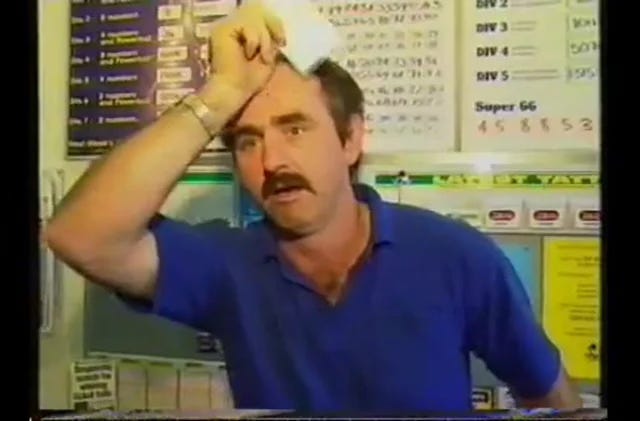
They invited him to take part in a news report. The idea was simple: return to the same shop, buy a similar scratch card, and recreate the moment. A re-enactment like so many others, something symbolic, for the camera. Bill agreed. In the end, it was just another gesture.
Bill buys the scratch card, sets it down and starts scratching. He looks up, eyes wide, expression frozen. And says: “I just won 250 thousand… I’m not kidding.”
250,000 Australian dollars. The re-enactment had just become real.
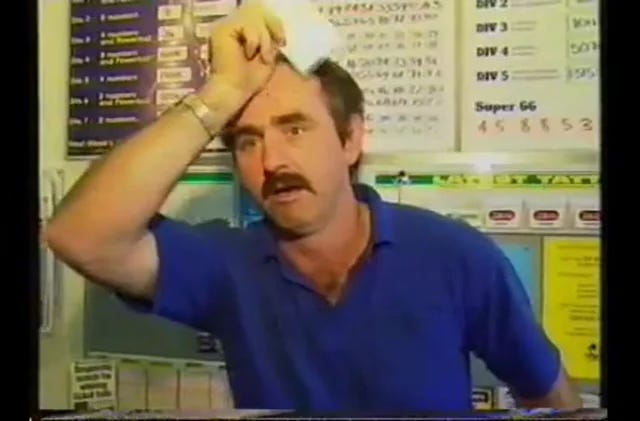
Around him, a mixture of silence and disbelief settles in. For seconds, nobody is quite sure what has just happened.
Still holding the ticket, Bill steps back slightly, as if his body is trying to catch up with what just occurred. A smile appears, but mixed with hesitation. He is visibly in shock. His hands tremble. He looks around, not quite knowing where to look, and ends up saying the first thing that comes to mind:
“Please don’t film me.”
Then, almost laughing at himself, he adds:
“I can’t believe this is happening… I think I’m going to have another heart attack.”
Still on camera, Bill calls his wife: “We’re going to get that house.”
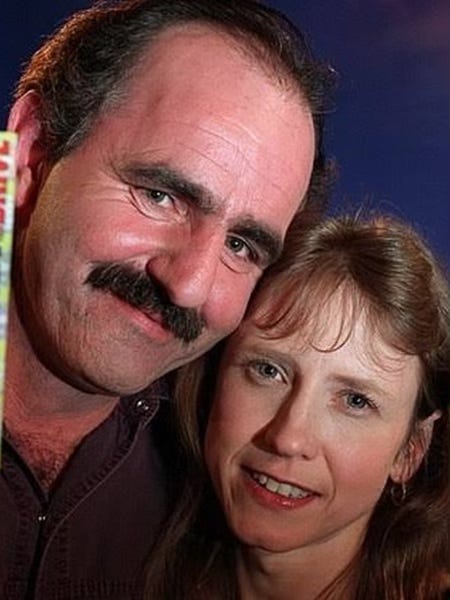
Bill and his wife moved out of the caravan and into a new home.
Years later
In 2020, Bill Morgan continues to live in Melbourne with his wife.
Health problems never disappeared completely. Between heart complications and arthritis, he ended up retiring earlier than expected. Even so, the way he looks at life has changed.
In an interview, he summed it all up simply:
“I got a 22-year bonus. Every day I wake up, put on my shoes and, even when I don’t feel very well, I take a short walk, smell the flowers, look at the sun and think about how lucky I am.”
He still buys a scratch card every week.