A 61-Year-Old Shepherd Showed Up at an 875 km Ultramarathon
And nobody understood what he was doing.
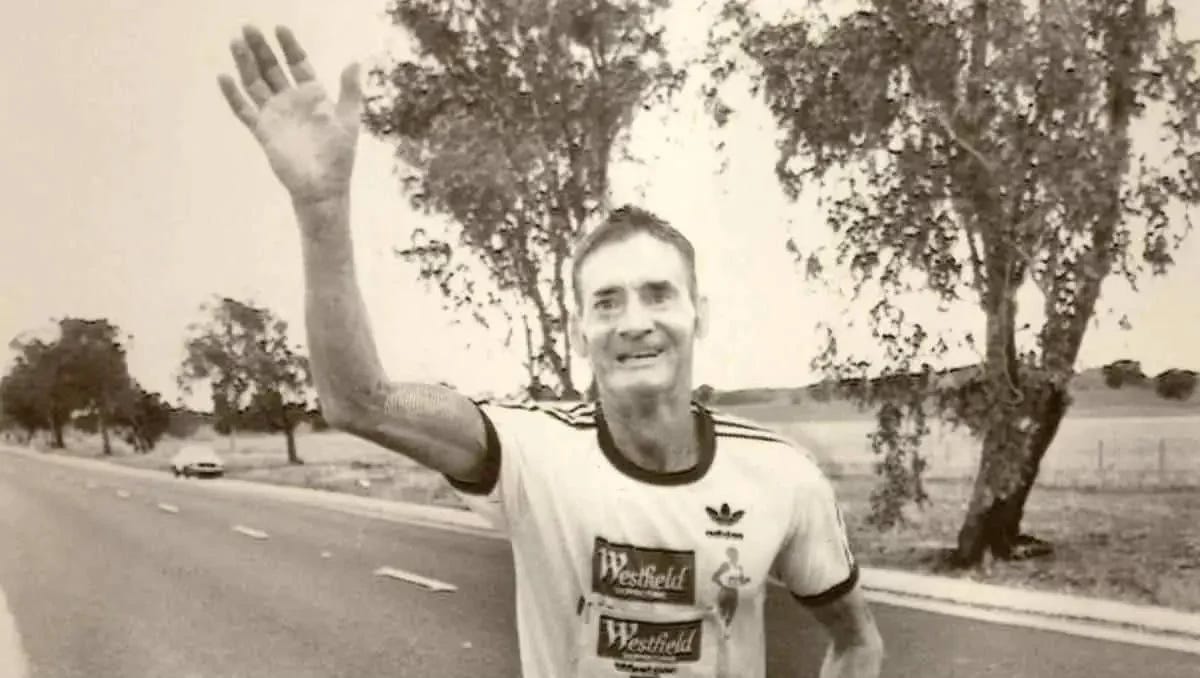
Sydney, Australia, 1983. Saturday 27 August, seven in the morning — the air is still cool. Someone says, behind the cameras, almost as if repeating something heard too many times:
— Eight hundred and seventy-five kilometres to Melbourne.
Another replies:
— Five days, if all goes well.
The runners are focused, each closed inside their own space, as if the race had already begun there. They stretch in silence, test their bodies, adjust small details only they seem to notice.
Fists clench, calves stretch against the asphalt still cold. Some stretch, others do a light warm-up.
On their wrists, digital watches are adjusted with almost ritual precision. On their feet, clean trainers, aggressive colours, some still too new for this distance. The brands repeat — recognizable even to those who do not run.
Some have been through this before. Around them, small teams speak quietly, exchange short, almost whispered instructions. Logos on shirts, legs, caps. Others barely speak at all.
And then there is a man who seems to have come to the wrong place. He is sixty-one years old. He wears overalls. Waterproof trousers cut by hand. And on his feet, galoshes. He does not warm up. He does not stretch. He stands there, still, as if waiting for something else.
Two journalists approach, half smiling.
— Did you come to watch the race?
He shakes his head.
— No. I’m going to run.
There is a short silence, the kind that never quite becomes awkward.
— And what do you do?
— I’m a farmer.
Pause, then he continues.
— I usually run after sheep.
The journalists exchange a quick glance, almost imperceptible. Someone laughs. Not too loudly. Behind them, someone says “875 kilometres” again, as if it matters to repeat it.
The man stands there, calm, as if none of this were particularly special. Nobody quite understands why he is there.
Before the start, some talk about the schedule as if talking about anything else.
— Eighteen hours today.
— Then we stop for six… sleep five.
There is no drama in the voice. It is just the plan. One of them points to his watch, as if already dividing the day into blocks. Another nods, confirms. They have done this before.
Further back, a support van has its doors open. Bottles lined up, energy gel, bags prepared, names written in marker. Someone is checking lists, counting things not clearly visible from here.
A runner bends down, tightens his laces. Another closes his eyes for a moment, as if storing energy before beginning to spend it.
They speak little, but when they do, they know exactly what they are talking about. Nobody there is improvising.
In another van, more discreet, there is only water, some vegetables and a thermos with tea.
When the race begins, the group sets off almost as one. For the first minutes they still seem together, but little by little the pace separates them. Bodies find cadence, strides lengthen, the sound becomes lighter, faster.
And then there is that man. He does not run like the others. His steps are short, almost shuffling, as if saving something he has not yet begun to use. His arms do not follow the rhythm. His body leans slightly forward, but without hurry. There is no acceleration, no attempt to keep up.
For the first minutes there is a moment of confusion. He heads in the wrong direction. Someone shouts for him to turn back. He turns, without hurry, and continues. The others pass him easily, one by one, without looking twice. In a few minutes he is alone. From a distance, his movement looks wrong. Awkward. As if he had started a different race.
When night falls, the rhythm changes. Support vans begin to appear more often at the roadside. Headlights on. Doors open. Someone calls a name.
One by one, the runners begin to stop. They sit on the ground, lean against the van wheel, take off their shoes. Hands help, low voices, movements already rehearsed. Some lie down almost immediately, as if the body already knows what to do.
The road, busy during the day, begins to empty. Fewer lights. Fewer steps. And then, almost nothing. Trucks pass too close. Wind pulls the body backward. Small stones rise from the asphalt.
That first night, his coach and masseur, Wally Zeuschner, who had poor eyesight, sets the alarm for two in the morning by mistake, when the intention was to wake him only around six. Cliff wakes, gets up and returns to the road still in darkness. For some time he does not understand what is happening, until he begins to find the absence of sunrise strange. He asks the coach, who answers only: “Keep running.”
Only one man keeps running. The same short, shuffling pace. Without looking sideways. Without hesitating. He passes a van where someone is sleeping. Then another. And another. Nobody says anything to him. He does not ask either. He continues. As if it were not yet time to stop.
In the morning, the road fills again. Runners reappear, one by one, out of the vans, still with the weight of short rest on their bodies. They resume pace, as if continuing something left on pause.
For some hours, everything seems normal again. But when night returns, the same gestures repeat: stop, sit, take off shoes, lie down.
And he continues. The same short step. The same lean of the body. The same pace that never changes. He passes the others while they sleep. Some do not even see him. By morning, he already held a lead of about 30 kilometres over the other runners.
On the second day, small differences begin to be noticed, almost imperceptible at first. A runner who was ahead no longer appears for some time. Another takes longer to return to the road after a stop. Positions are no longer as clear as on the first day, but nobody seems worried about it.
During the night, while some rest in the vans or lean against the roadside, he passes them without changing pace, as if merely continuing a movement that needs no interruption.
He does not accelerate. He does not observe. He does not react.
In the morning, some overtake him again, recovered by a few hours, still within the plan they defined before the start.
As the days advance, there are fewer and fewer runners ahead of him, and more behind. The gap settles in without announcement, without a clear moment when everything changes. Nobody sees exactly when it happens. When they notice, there is already more space ahead than behind. And he continues, inside that space, with the same step as always.
On the third day, his name begins to appear more often. First among organizers, in quick, almost logistical conversations, as if confirming a detail that does not add up. One of them looks at a list, looks again, and calls another to confirm.
Later, journalists begin to approach the road at points where they know he will pass. They are no longer there by chance. They wait. When he appears, the movement is always the same. He does not slow down, does not lift his head, does not react to the cameras.
Someone says his name aloud, as if testing it. He does not answer. During the day, more people begin to talk about him. In the vans, at stops, among those following the race from a distance.
He stops being merely that strange man at the start. He is not yet a favourite. But he no longer goes unnoticed.
On the fifth day, the finish line is already prepared. People are waiting, but not in numbers enough for what is about to happen. Some organizers look at the road, again and again. Someone says he is close.
When he finally appears, there is no acceleration or final gesture. The movement is exactly the same as on the first day — short step, steady, slightly leaning forward.
As he approaches the city, some people begin to run beside him. First a few. Then more. There is noise, but he does not react. He approaches without hurry.
He crosses the line almost the same way he crossed everything else. Without raising his arms. Without stopping immediately. Only afterwards does he slow down. The time is recorded: five days, fifteen hours and four minutes. Second place is more than ten hours behind.
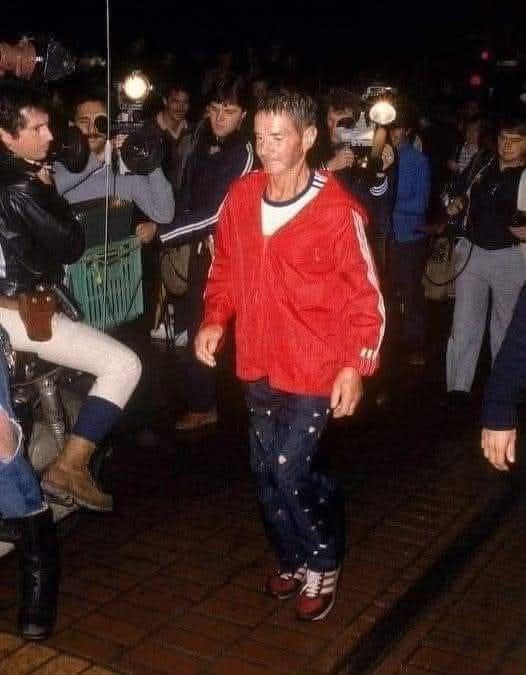
For a few seconds, there is a strange silence, as if nobody had properly prepared for that moment. He stands there, calm, as if he had merely finished another day of work.
Only later do they explain that there was a prize. The winner received ten thousand dollars. He listens carefully and nods slightly, as if merely confirming he understood, without much reaction.
He asks no questions. Stands there for some time, as if still trying to understand what it means. Then he says he does not need the money, and that other runners fought just as hard to get there. He decides to split it among the first five.
He does it without ceremony, without any speech, as if it were the most natural thing. Later, someone asks why he never stopped to sleep.
He looks, surprised, as if the question does not make much sense. And answers:
— I thought you weren’t allowed to stop. That you were supposed to run until the end.
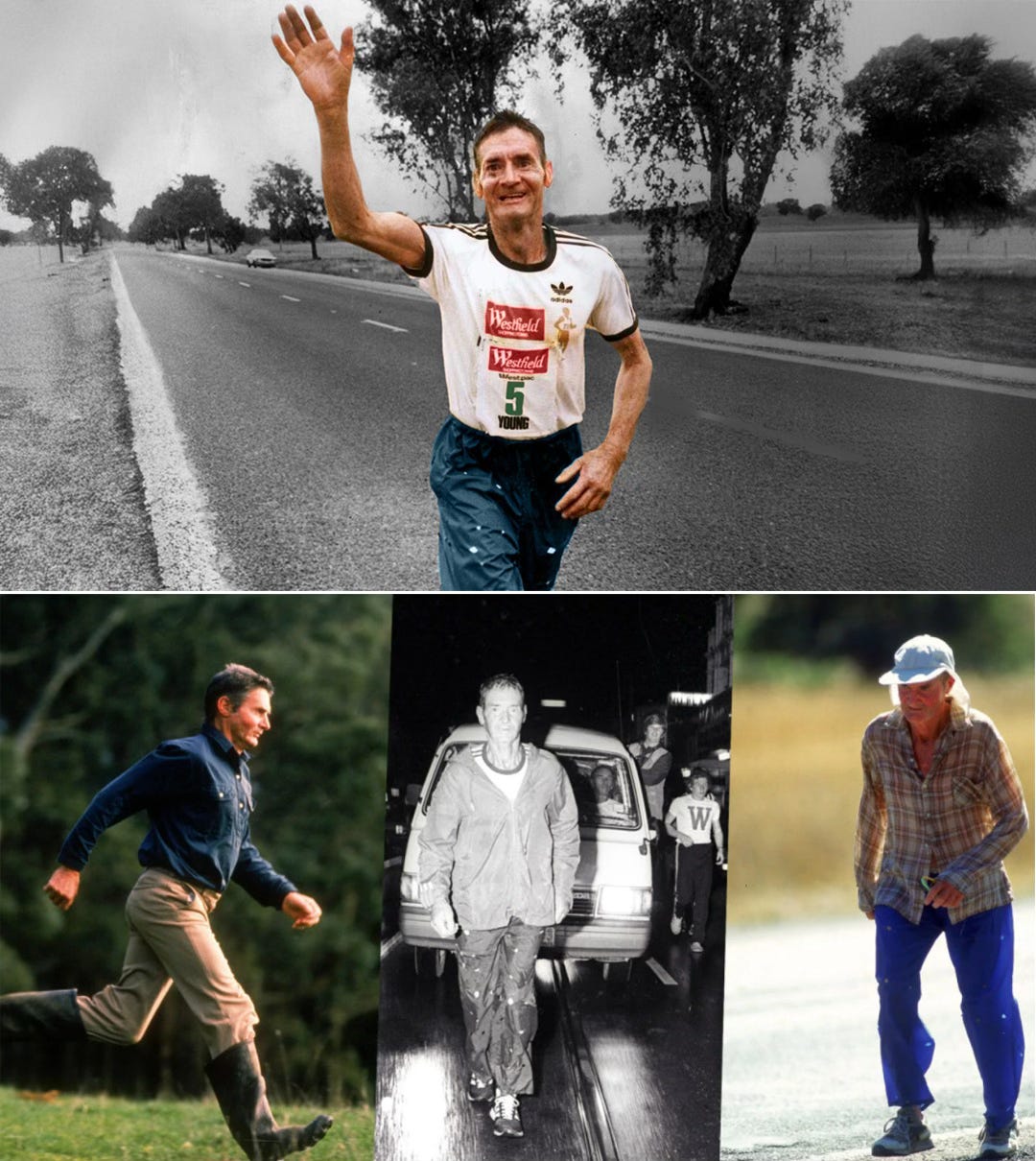
Years later
His name still appears, in races, in stories, in conversations among people who never saw him run.
Some try to copy the movement.
Short steps. Body leaning forward. Steady pace. It does not always work.
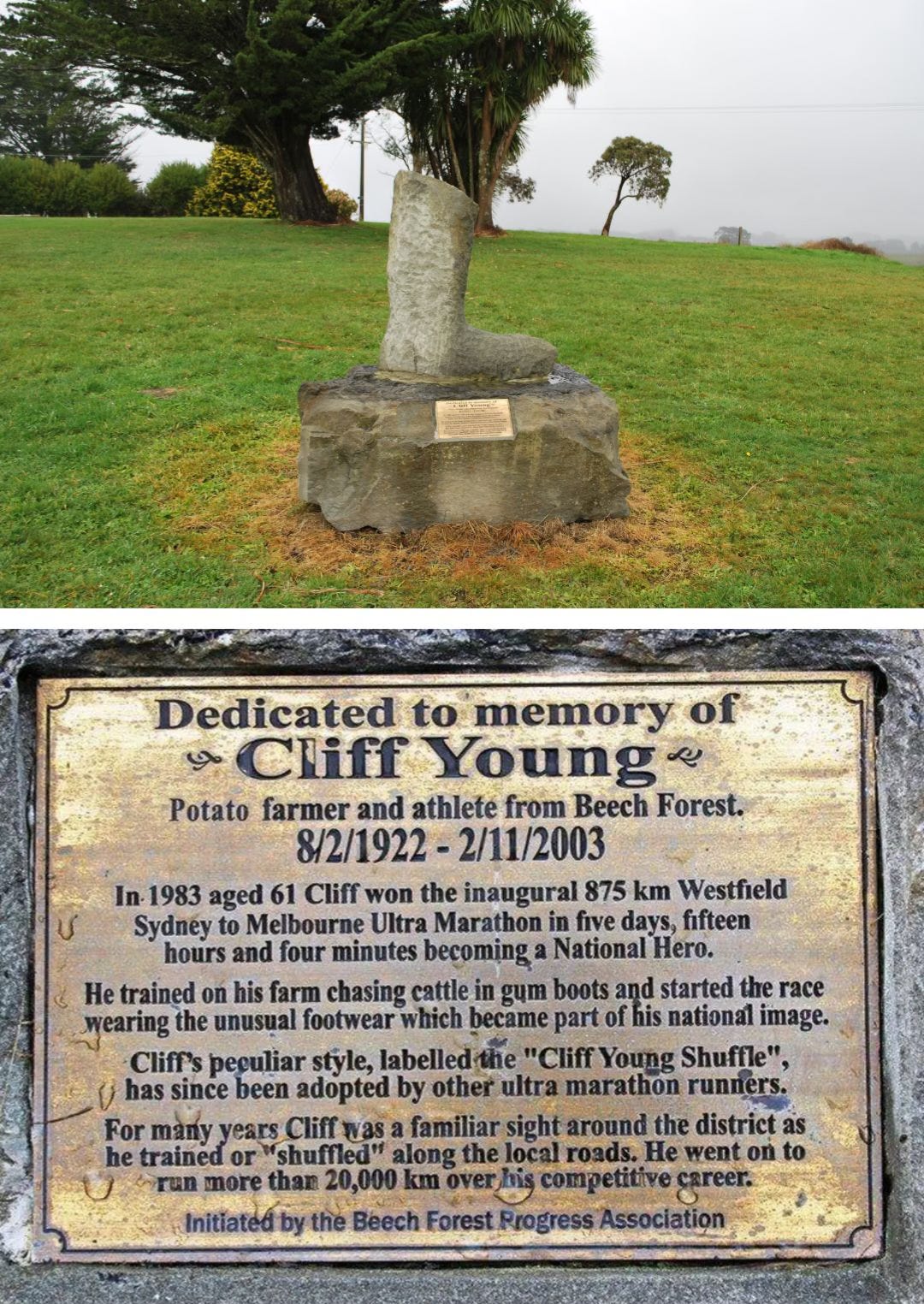
He died in 2003, at eighty-one.
Curiosity: The step that looked wrong
The “shuffle” looked wrong — but it worked
Cliff Young’s running style became known as the Cliff Young Shuffle. At first glance it looked awkward, almost shuffling, but it proved surprisingly efficient over long distances.
He ran lower, spent less energy: Instead of lifting his feet high, he kept them close to the ground, with short, continuous steps. That reduced effort and allowed him to keep moving for hours when others already needed to stop.
The body absorbed impact differently: Unlike traditional running, where impact often falls on the joints, his style distributed that effort better through the body, which helped him endure hundreds of kilometres.
The rhythm never broke: He maintained a steady cadence, without overextending his stride. There were no peaks or accelerations — only continuity.
It was born on the farm, not in training: None of this was learned on a track. The movement came from years running after sheep, often in galoshes, on uneven ground and for long periods.
It ended up influencing other runners: After his victory, the “shuffle” stopped being seen as a curiosity and began to be tried by other athletes, especially in ultra-endurance events.
It is still used today: In some ultramarathons, this type of running continues to be taught as a way to conserve energy over great distances.
Plastic trousers: At a certain point in the race, he wore waterproof plastic trousers (similar to golf trousers), in which he cut holes for ventilation; these were his only trousers from start to finish.
—